10 Best 3D Printer Scanners 2026 in the United States


Related Products
Up to 9% off
Our technology thoroughly searches through the online shopping world, reviewing hundreds of sites. We then process and analyze this information, updating in real-time to bring you the latest top-rated products. This way, you always get the best and most current options available.

Our Top Picks
Winner
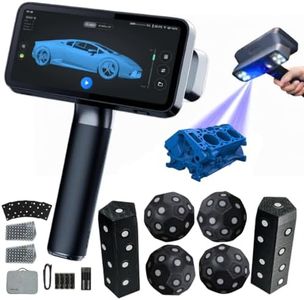
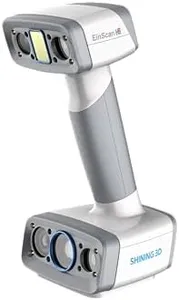
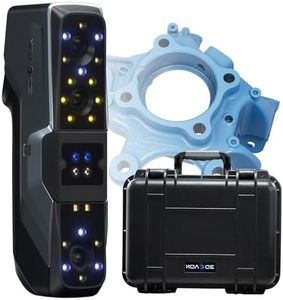
EinScan Rigil 3D Scanner for Reverse Engineering Wireless Portable Handheld
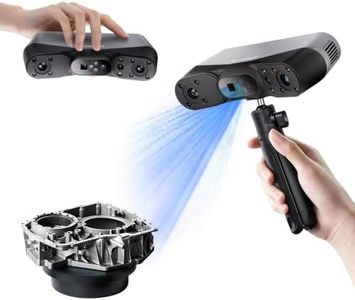
The EinScan Rigil 3D Scanner is a versatile and portable device designed for professionals needing high precision, such as in automotive design, engineering, and reverse engineering. It uses advanced hybrid light technology combining blue laser and infrared, achieving an excellent accuracy of 0.04mm, which is impressive for capturing detailed and complex surfaces. The scanner's ability to handle dark and reflective objects without additional sprays is a major plus, making it useful for scanning materials like metal parts or shiny prototypes. It offers multiple scanning modes, including wireless and standalone options, boosting flexibility for on-site or studio work. Thanks to its built-in computing power and fast processing, scanning and data handling are smooth and efficient, supported by a sharp 6.4-inch touchscreen that improves usability. The scanner is relatively heavy at nearly 13 pounds but comes with a carrying case and replaceable batteries, enhancing portability despite the weight.
The package is comprehensive, including several accessories and even personalized online training, which helps users get started with ease. The scanner’s size and weight may limit extended handheld scanning sessions or very large objects. Its niche focus suggests it is more suited for specialized industrial users rather than casual or hobbyist use. This powerful and user-friendly scanner is ideal for professionals who require accurate, marker-free scans of challenging surfaces, combined with the freedom to scan wirelessly and in varied environments.
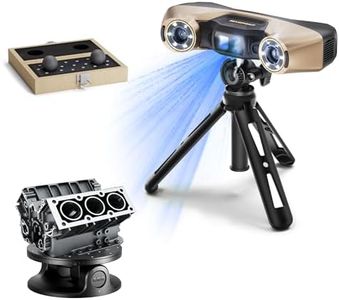
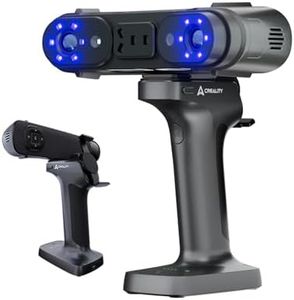
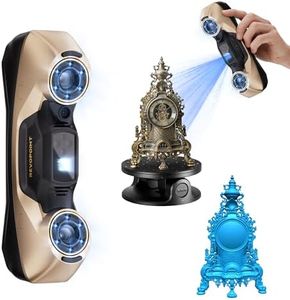
Revopoint MIRACO Plus 3D Scanner for 3D Printing Handheld, 3D Printer Scanner with Photogrammetry, Up to 0.02mm Precision, Full-Color Scan for Small to Large Objects, 32GB RAM
Most important from
39 reviews
The Revopoint MIRACO Plus is a versatile handheld 3D scanner designed to capture detailed 3D models suitable for 3D printing and reverse engineering. It offers impressive accuracy, with photogrammetric metrology providing up to 0.02 mm precision, which is excellent for capturing fine details on both small and large objects. Its quad depth camera and infrared zoom options help scan a wide range of sizes—from tiny screws to big machinery—making it quite flexible. The 48MP color camera with built-in lighting ensures lifelike color scans, adding realistic textures to your models.
The scanner supports two scanning modes: a precise single-shot mode for detailed captures and a faster continuous mode, which balances quality and speed depending on your needs. Its hardware is solid, featuring an 8-core processor and 32GB of RAM, so it can handle large scan files smoothly, although it requires a fairly powerful computer (Intel i7 or M1 Pro and above) for best performance. Software compatibility is good, with the device working on Windows and macOS and supporting common 3D file formats. The included software is user-friendly for scanning and editing, but the advanced CAD conversion tool (Revo Design) is sold separately.
Portability is a strong point: the scanner is lightweight (750g) and comes with a robust carrying case and a battery offering about 2 hours of use with fast charging. This makes it convenient for on-site scanning tasks. Its resolution is 2 megapixels, which is decent though not top-tier compared to some professional scanners. Some users may find the minimum computer requirements demanding if they do not have a modern PC or laptop. The MIRACO Plus is well-suited for professionals and enthusiasts looking for a high-accuracy, portable 3D scanner that can handle various object sizes and produce full-color models, with strengths in precision, versatility, and ease of use, while requiring compatible hardware and possibly additional software for full CAD functionality.
Most important from
39 reviews
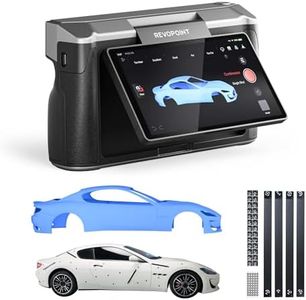
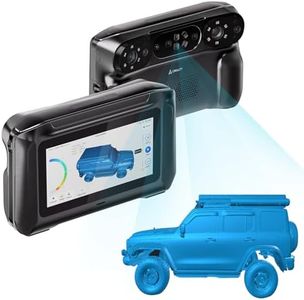
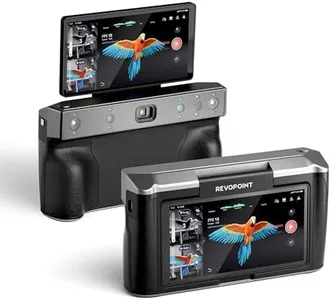
Revopoint MIRACO Pro Wireless 3D Scanner for 3D Printing, All-in-one Handheld 3D Printer Scanner, Up to 0.02 mm Precision, Full Color Scan Support for Small to Large Objects, 32GB RAM
Most important from
9 reviews
The Revopoint MIRACO Pro Wireless 3D Scanner is a versatile handheld device designed to scan objects ranging from tiny screws to large machinery with high detail. It achieves impressive precision with up to 0.02 mm accuracy, making it suitable for detailed 3D printing needs. Thanks to its 48-megapixel color camera and LED lighting, it creates vibrant, photorealistic scans. The scanner offers flexible scanning modes—continuous scanning up to 15 frames per second for speed, or single-shot mode for capturing intricate details with minimal errors. Its scan volume is broad, adapting easily from small to large items using a dual-depth camera system.
A standout feature is its all-in-one design, allowing you to scan, edit, and review models directly on its bright 2K 6-inch touchscreen without needing a computer. It also supports wireless and USB transfers to macOS or Windows, with common 3D file formats compatible with most 3D printing software. On the software side, the included Revo Design supports efficient conversion to CAD models, although it is Windows-only and sold separately, which may add to the cost.
Portability is excellent since the scanner weighs just 750 grams, is compact, and runs on a rechargeable battery that lasts about two hours, suitable for fieldwork or on-the-go scanning. Some users might find the advanced features require a learning curve, and the paid software could be a drawback for those wanting a fully included solution. Customer reviews are positive, indicating a solid product that meets the needs of hobbyists and professionals looking for a portable, accurate, and flexible 3D scanner with good color capture.
Most important from
9 reviews
Buying Guide for the Best 3D Printer Scanners
Choosing the right 3D printer scanner can be a bit overwhelming, but with the right approach, you can find the perfect fit for your needs. The key is to understand the specifications that matter most and how they align with what you plan to do. Whether you're a hobbyist, a professional, or someone in between, knowing what to look for will help you make an informed decision.FAQ
Most Popular Categories Right Now


