6 Best Moog Synthesizers 2026 in the United States


Related Products
Up to 15% off
Our technology thoroughly searches through the online shopping world, reviewing hundreds of sites. We then process and analyze this information, updating in real-time to bring you the latest top-rated products. This way, you always get the best and most current options available.

Our Top Picks
Winner
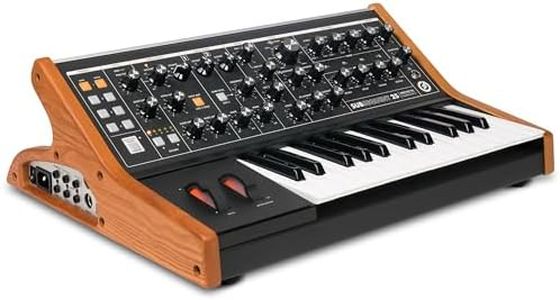
MOOG Subsequent 25 Paraphonic Analog Synthesizer and MIDI Keyboard with 25 Semi Weighted Keys, Headphone Amp, 16 Presets and Editor/Librarian Software
Most important from
101 reviews
The MOOG Subsequent 25 Paraphonic Analog Synthesizer stands out as a versatile tool for musicians, particularly those looking to explore deep sound design in a compact format. Its 25 semi-weighted keys provide a responsive playing experience, making it suitable for both studio work and live performances. The paraphonic capability allows for unique layering of sounds, enhancing your creative options, especially in crafting powerful bass patches. You can easily stack oscillators for rich tones or split them for a wider sonic range, which is a notable strength for bass enthusiasts.
On the connectivity front, the synthesizer covers all bases with MIDI In/Out, USB, and audio connections, offering flexibility whether you’re connecting to a computer or integrating with other gear. The included editor/librarian software adds convenience, allowing users to manage presets effectively, making it a great choice for those who enjoy customizing their sounds.
However, while the Subsequent 25 is powerful, it may feel slightly limiting for users seeking extensive polyphony, as it only supports two-note paraphonic play. This might be a drawback for those who want to create more complex layered sounds. Additionally, with a weight of over 16 pounds, it’s not the lightest synth out there, which could be a consideration for traveling musicians. The user interface is generally intuitive, but beginners may initially find some of the modulation options and advanced features overwhelming without prior experience with synthesizers. Despite this, with a little practice, many users can start creating music quickly. The Subsequent 25 is tailored for adult musicians, particularly those who appreciate the blend of analog warmth with modern functionality.
Most important from
101 reviews
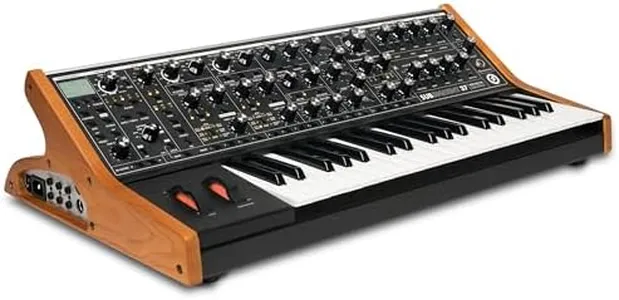
MOOG Subsequent 37 Paraphonic Analog Synthesizer and MIDI Keyboard with 37 Semi Weighted Keys, Headphone Amp, 256 Presets, Screen and Software Editor
Most important from
101 reviews
The Moog Subsequent 37 Paraphonic Analog Synthesizer is a powerful choice for serious musicians and sound designers looking for a versatile instrument. With 37 semi-weighted keys that offer aftertouch and velocity sensitivity, it enhances playability, making it suitable for expressive performances. The synth features two Variable Waveshape Oscillators and a Square Wave Sub Oscillator along with an Analog Noise Generator, providing a rich palette of sounds that can be easily manipulated. Its paraphonic capability allows for two-note polyphony, which is a fun addition for creating layered textures.
One of the standout elements is the extensive control panel, which includes 40 knobs and 74 switches. This setup offers immediate access to a myriad of sound-design options, making it appealing for those who love to tweak settings in real-time. The complex modulation possibilities are another highlight, featuring two modulation busses that include an LFO and programmable routing, which can lead to unique soundscapes.
The Subsequent 37 may not be the best fit for beginners, as it falls into the professional skill level category. Its advanced features might overwhelm new users who are just starting with synthesizers. Additionally, while the editor/librarian software is a great tool for managing presets, some users may find it challenging to navigate without prior experience. Connectivity options are comprehensive, including MIDI In/Out/USB and various audio outputs, making it easy to integrate into existing setups. The synth also weighs a considerable 22 pounds, which could be a drawback for portable use. Despite these minor drawbacks, the Moog Subsequent 37 stands out as an exceptional instrument for professionals looking to explore the depths of analog synthesis.
Most important from
101 reviews
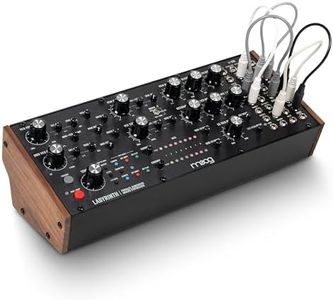
MOOG Labyrinth - Semi-Modular Parallel Generative Analog Synthesizer with Dual Sequencer, Dual Oscillators, VC Wavefolder, VC Filter, Patch Bay
The MOOG Labyrinth is a semi-modular analog synthesizer designed for those who enjoy sonic exploration and creativity. It features dual oscillators, which are excellent for producing unique, low-harmonic sounds, making it ideal for crafting metallic FM and wavefolding textures. The inclusion of a dual sequencer adds flexibility, allowing users to create evolving sequences that enrich musical compositions. Its Voltage-Controlled Wavefolder and state-variable filter broaden the spectrum of sound design, offering smooth transitions between lowpass and bandpass filters for a dynamic audio experience.
The Labyrinth's patch bay, featuring 32 jacks, offers substantial connectivity options, essential for those who desire customization and experimentation with sound routing. The relatively compact and lightweight design makes it a practical choice for tabletop setups, while the user-friendly interface, supported by patch sheet overlays and a comprehensive guide, makes it accessible even to those newer to semi-modular systems.
The instrument's semi-modular nature may present a learning curve for complete beginners, as it requires an understanding of patching to fully utilize its potential. Also, as it lacks polyphony, it's more suited for monophonic sequences rather than polyphonic arrangements. For enthusiasts seeking a fresh approach to sound design, particularly in experimental or electronic genres, the MOOG Labyrinth offers a robust platform. It's a tool for adding texture and depth to compositions, particularly when paired with rhythmic elements like drums or basslines.
Buying Guide for the Best Moog Synthesizers
Choosing the right Moog synthesizer can be an exciting journey, as these instruments are known for their rich, warm sounds and versatility. To find the best fit for you, it's important to understand the key specifications and how they align with your musical needs and preferences. Here are some essential specs to consider when selecting a Moog synthesizer.FAQ
Most Popular Categories Right Now


