10 Best Oscilloscope Multimeters 2026 in the United States

Related Products
Up to 29% off


Our technology thoroughly searches through the online shopping world, reviewing hundreds of sites. We then process and analyze this information, updating in real-time to bring you the latest top-rated products. This way, you always get the best and most current options available.

Our Top Picks
Winner
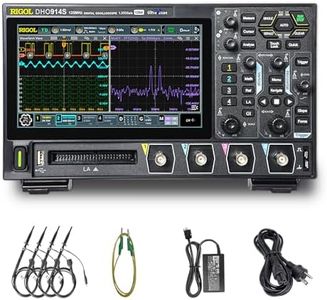
RIGOL Digital Oscilloscope DHO914S 125 MHz 4-Ch + 16 Digital 1.25 GSa/s 12-bit 50 Mpts UltraAcquire 1,000,000 wfms/s AFG + Bode Plot LAN/USB/HDMI SCPI for Power & Embedded
Most important from
33 reviews
The RIGOL Digital Oscilloscope DHO914S stands out in the oscilloscope-multimeter category thanks to its impressive specifications and user-friendly features. With a bandwidth of 125MHz and a maximum sample rate of 1.25 GSa/s, it’s particularly well-suited for capturing high-frequency signals in various applications, making it a solid choice for both professionals and hobbyists. The 4 analog channels allow for versatile signal analysis, and the option to add 16 digital channels enhances its functionality even further.
One of the key strengths of this model is its ultra-low background noise, which ensures that even small signals are captured accurately. The 12-bit vertical resolution provides high-quality measurements, and the vertical sensitivity range from 200 μV/div to 10 V/div caters to a broad spectrum of applications. The 7-inch high-definition touchscreen is a significant improvement in user experience, allowing for easy navigation and analysis.
There are some drawbacks worth noting. The complexity of features, including arbitrary waveform generation and advanced digital signal analysis, might overwhelm beginners who are not familiar with oscilloscopes. While the device offers excellent connectivity options such as USB, LAN, and HDMI, users may require additional time to fully leverage these features. In terms of build quality, the oscilloscope is relatively lightweight at 3.9 lbs, making it portable, but its compact dimensions might be limiting for those who prefer larger screens for detailed work. Additionally, while the product comes with a generous 3-year warranty, users should consider the potential learning curve associated with mastering its capabilities.
Most important from
33 reviews
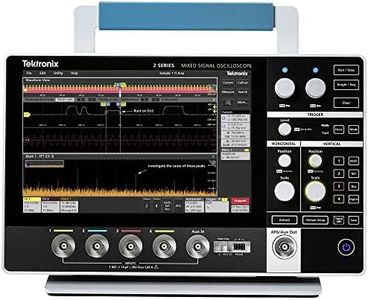
Tektronix MSO24 2-BW-100 100 MHz, 4 Channels Mixed Signal Oscilloscope
The Tektronix MSO24 2-BW-100 is a mixed signal oscilloscope designed with 4 analog channels and a 100 MHz bandwidth, making it suitable for capturing and analyzing moderate-frequency signals. Its sample rate is quite good, offering 2.5 billion samples per second when using half the channels and 1.25 billion samples per second when all four channels are active. This ensures you can see detailed waveform data for a variety of electronic troubleshooting or design tasks.
The device supports a large memory depth with 10 million points per channel, allowing longer signal recordings without losing detail. It features an 8-bit ADC resolution and an optional higher-resolution mode (16 bits), which helps in getting clearer signal views when needed. The product dimensions and weight are manageable for a benchtop instrument.
This oscilloscope serves as a solid option for students, hobbyists, or engineers working with signals under 100 MHz who need reliable basic functionality without extra bells and whistles. It is more of a niche or entry-level choice rather than a top seller, which might reflect pricing or feature limitations compared to higher-end models.
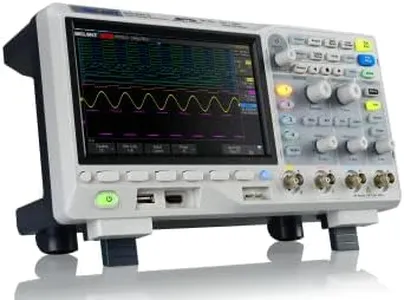
Siglent Technologies SDS1204X-E 200MHz Super Phosphor Digital Oscilloscopes 4 Channels 1 GSa/s 14 MB Grey
Most important from
82 reviews
The Siglent SDS1204X-E is a solid choice if you're looking for a digital oscilloscope that handles a variety of signals with good detail. It offers a 200 MHz bandwidth and a fast 1 GSa/s sample rate, which means it can capture rapid changes in signals accurately, suitable for most hobbyists and professionals working on electronics testing. With 4 channels, you can monitor multiple signals at once, which is handy for complex troubleshooting. The 7-inch color display is clear and sharp, making it easier to see waveforms and navigate menus. It also provides a fairly large memory depth of 14 million points, allowing longer signal captures without losing detail. The intelligent trigger options help isolate specific events in your signal, which is useful when looking for irregular or rare occurrences. Voltage scales from 500 µV/div to 10 V/div cover a wide range of signal strengths.
The device is relatively lightweight and not discontinued, meaning support and accessories should be available. This oscilloscope serves electronics enthusiasts, students, and engineers who need a capable and reliable instrument without getting too complicated.
Most important from
82 reviews
Buying Guide for the Best Oscilloscope Multimeters
When choosing an oscilloscope-multimeter, it's important to understand that this device combines the functionalities of both an oscilloscope and a multimeter. This means it can measure electrical signals and display them graphically, as well as measure voltage, current, and resistance. To pick the best fit for you, consider the key specifications and how they align with your specific needs and applications.FAQ
Most Popular Categories Right Now


