We Use CookiesWe use cookies to enhance the security, performance, functionality and for analytical and promotional activities. By continuing to browse this site you are agreeing to our privacy policy

10 Best Cell Boosters 2026 in the United States
How do we rank products for you?

Our technology thoroughly searches through the online shopping world, reviewing hundreds of sites. We then process and analyze this information, updating in real-time to bring you the latest top-rated products. This way, you always get the best and most current options available.

headphones-stars

Our Top Picks

#1

Winner

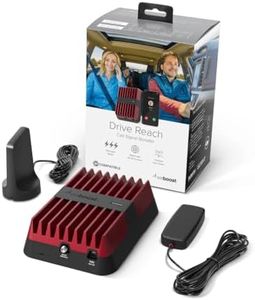
weBoost Drive Reach - Vehicle Cell Phone Signal Booster | 5G & 4G LTE | Magnetic Roof Antenna | Boosts All U.S. Carriers - Verizon, AT&T, T-Mobile | Made in the U.S. | FCC Approved (model 470154)

Rating
10.0
Chosen by1,207
Installation Type
Coverage Area
Frequency Bands

Most important from
2782 reviews

Installation Type
Installation is straightforward and convenient, especially with the magnetic roof antenna that requires no professional help.
Coverage Area
Performance can vary depending on initial signal availability, as boosters amplify existing signals but cannot create coverage where none exists.
Frequency Bands
While it excels at increasing upload speeds, the booster also provides a solid overall signal enhancement for multiple carriers and 5G networks.

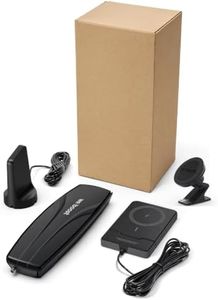
The weBoost Drive Reach is designed to boost cell signals for vehicles, making it a strong choice for people who often find themselves with weak reception while driving. It covers all major U.S. carriers such as Verizon, AT&T, and T-Mobile, and supports the latest 5G technology, so it helps improve both call quality and mobile data speeds for several devices at once. With a maximum gain of 50 dB, it can reach distant cell towers more effectively than many other boosters, which means better coverage on the road.

The installation is relatively simple, using a magnetic roof antenna that’s easy to mount without complicated hardware. This makes it convenient if you want a booster that’s mobile and doesn’t require professional installation. On the downside, it doesn’t support smart home integration, so it’s solely focused on vehicle use. Also, while it’s FCC approved and backed by a 2-year warranty, some users might find the size of the booster unit a bit bulky compared to smaller models.

Customer reviews are generally positive, with a solid 4.1 out of 5 stars, indicating that most users see real improvements in signal strength. For those seeking a reliable car signal booster that handles multiple users and the newest networks, the Drive Reach provides a good balance of power and ease of use, especially for frequent travelers through areas with spotty coverage.

Rating
10.0
Chosen by1,207
Installation Type
Coverage Area
Frequency Bands

Most important from
2782 reviews

Installation Type
Installation is straightforward and convenient, especially with the magnetic roof antenna that requires no professional help.
Coverage Area
Performance can vary depending on initial signal availability, as boosters amplify existing signals but cannot create coverage where none exists.
Frequency Bands
While it excels at increasing upload speeds, the booster also provides a solid overall signal enhancement for multiple carriers and 5G networks.
#2

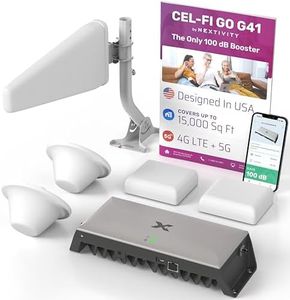
Nextivity CEL-FI GO G41 Cell Phone Booster for Home 4G, 5G, AT&T, Verizon & T-Mobile Up to 15,000 Sq Ft Coverage 100 dB Cell Phone Signal Booster FCC Approved (2X Indoor Antenna Kit)

Rating
8.8
Coverage Area
Frequency Bands
Gain

Most important from
687 reviews

Coverage Area
Delivers a dramatic improvement from weak or spotty signal to full bars and LTE, enabling seamless streaming and hotspot use without lag or buffering.
Frequency Bands
Switching between carriers and tuning the system to find the best signal is straightforward thanks to the intuitive software and app integration.
Gain
The booster’s high gain and ability to pull in weak signals from miles away make it uniquely effective for rural, metal, or heavily obstructed environments.
Installation Type
Installation requires some mechanical skill and time, but clear instructions and app-guided setup make the process manageable and rewarding.

The CEL-FI GO G41 is a powerful cell phone booster designed for home use, offering coverage up to 15,000 square feet, which is excellent for large houses or multi-level homes. It supports 4G and 5G signals across major US carriers including AT&T, Verizon, and T-Mobile, making it very versatile. One of its standout features is the high gain of 100 dB, which means it amplifies signals much more strongly than many competitors—enough to cover an entire home with one device rather than needing multiple boosters. It also uses an advanced 4th generation chipset that is future-ready for 5G enhancements coming soon, ensuring your signal remains fast and reliable.

The included antenna kit, with two dome and two panel indoor antennas plus one outdoor antenna, gives some flexibility for optimizing signal reception and distribution inside the house. Installation is moderately involved, as it requires mounting the outdoor antenna and placing indoor antennas strategically, so some DIY comfort is helpful. The unit is FCC certified, so it meets regulatory standards for safety and signal interference.

A consideration is that the booster is fairly heavy and bulky, which could be important if space or ease of setup is a priority. The CEL-FI GO G41 is a strong choice if you want reliable, whole-home signal improvement with future-proof technology, especially in areas with weak outdoor signals.

Rating
8.8
Coverage Area
Frequency Bands
Gain

Most important from
687 reviews

Coverage Area
Delivers a dramatic improvement from weak or spotty signal to full bars and LTE, enabling seamless streaming and hotspot use without lag or buffering.
Frequency Bands
Switching between carriers and tuning the system to find the best signal is straightforward thanks to the intuitive software and app integration.
Gain
The booster’s high gain and ability to pull in weak signals from miles away make it uniquely effective for rural, metal, or heavily obstructed environments.
Installation Type
Installation requires some mechanical skill and time, but clear instructions and app-guided setup make the process manageable and rewarding.
#3

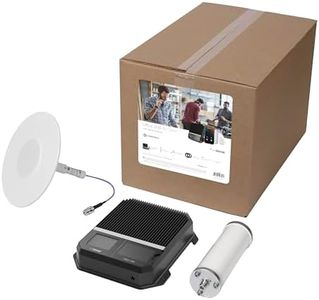
weBoost for Business Office 200 (50 Ohm) Cell Phone Signal Booster | 5G/4G LTE | 72 dB | DIY | All U.S Carriers - Verizon, AT&T, T-Mobile & more | Up to 12,000 sq ft | FCC Approved | 472047

Rating
8.8
Coverage Area
Number of Users
Installation Type

Most important from
21 reviews

Coverage Area
Quickly improved signal strength from 1 to 3 bars, covering an office space over 100 ft long and 75 ft wide.
Number of Users
Staff who couldn't use their phones before can now do so, proving the booster works as described.
Installation Type
Installation took a few hours but resulted in reliable and effective signal enhancement.

The weBoost Office 200 is designed for businesses seeking to enhance their cell signal coverage, making it a strong contender in the cell booster category. With a coverage area of up to 10,000 square feet, it can support larger office spaces, which is a significant advantage for companies with multiple employees or large layouts. This model is compatible with all US carriers and supports both 4G LTE and 5G technology, ensuring that you can enjoy faster data speeds for tasks like messaging, streaming, and using POS systems.

One of the notable strengths of this product is its professional installation service. While some users may prefer a DIY option, having a professional set it up can ensure optimal placement and efficiency. The fact that it automatically adjusts to variations in signal strength also adds to its reliability, especially in environments influenced by building materials or distance from cell towers.

However, there are some drawbacks to consider. The requirement for professional installation could be a hurdle for some users, as it adds to the overall cost and may delay the time it takes to get the system up and running. Additionally, weighing 21.9 pounds and with dimensions of 19 x 13 x 13 inches, it may be bulky for smaller office spaces or setups. Despite its solid performance, the product has a relatively modest customer review rating of 4.6 out of 5 from only six ratings, which suggests that it may not have widespread user feedback yet.

Rating
8.8
Coverage Area
Number of Users
Installation Type

Most important from
21 reviews

Coverage Area
Quickly improved signal strength from 1 to 3 bars, covering an office space over 100 ft long and 75 ft wide.
Number of Users
Staff who couldn't use their phones before can now do so, proving the booster works as described.
Installation Type
Installation took a few hours but resulted in reliable and effective signal enhancement.

Buying Guide for the Best Cell Boosters

Choosing the right cell booster can significantly improve your mobile signal strength, ensuring better call quality and faster data speeds. A cell booster, also known as a signal booster, works by amplifying weak cellular signals and rebroadcasting them within a specific area. To find the best cell booster for your needs, it's important to understand the key specifications and how they relate to your specific situation. Here are the main factors to consider when selecting a cell booster.
Coverage AreaThe coverage area of a cell booster indicates the maximum space it can effectively cover with an improved signal. This is important because it determines how much of your home, office, or vehicle will benefit from the boosted signal. Coverage areas are typically measured in square feet. Small boosters cover areas up to 1,500 square feet, suitable for single rooms or small apartments. Medium boosters cover between 1,500 to 5,000 square feet, ideal for larger homes or small offices. Large boosters cover over 5,000 square feet, perfect for large buildings or multiple floors. Choose a booster that matches the size of the area where you need improved signal.
Frequency BandsCell boosters operate on specific frequency bands that correspond to the frequencies used by cellular carriers. This is important because the booster must support the frequency bands used by your carrier to effectively amplify the signal. Common frequency bands include 700 MHz, 850 MHz, 1700/2100 MHz, and 1900 MHz. To navigate this, check which frequency bands your carrier uses and ensure the booster supports those bands. If you use multiple carriers, look for a multi-band booster that supports all the necessary frequencies. This ensures compatibility and optimal performance.
GainGain, measured in decibels (dB), indicates the strength of the signal amplification provided by the booster. This is important because higher gain means a stronger and more reliable signal. Gain values typically range from 50 dB to 70 dB. Low gain (50-60 dB) is suitable for areas with moderately weak signals and smaller coverage areas. High gain (60-70 dB) is better for areas with very weak signals and larger coverage areas. Choose a booster with the appropriate gain based on the strength of the existing signal and the size of the area you need to cover.
Number of UsersThe number of users a cell booster can support simultaneously is crucial if you have multiple people needing improved signal at the same time. This is important because some boosters are designed for single-user use, while others can support multiple users. Single-user boosters are suitable for personal use in vehicles or small spaces. Multi-user boosters are ideal for homes, offices, or larger spaces where several people need a better signal. Consider the number of people who will be using the booster and choose one that can handle the expected load.
Installation TypeThe installation type of a cell booster refers to how and where the booster is set up. This is important because it affects the ease of installation and the effectiveness of the booster. There are two main types: plug-and-play and professional installation. Plug-and-play boosters are easy to set up and are suitable for small areas or vehicles. Professional installation boosters may require more complex setup and are better for larger areas or buildings. Choose an installation type that matches your technical skills and the complexity of the area where you need improved signal.

FAQ

Most Popular Categories Right Now