We Use CookiesWe use cookies to enhance the security, performance, functionality and for analytical and promotional activities. By continuing to browse this site you are agreeing to our privacy policy

10 Best Compressor Pedals 2025 in the United States

How do we rank products for you?

Our technology thoroughly searches through the online shopping world, reviewing hundreds of sites. We then process and analyze this information, updating in real-time to bring you the latest top-rated products. This way, you always get the best and most current options available.

headphones-stars

Our Top Picks

#1

Winner

Donner Compressor Pedal, Ultimate Comp 2 Modes Compression Effect Pedal Pure Analog for Electric Guitar and Bass True Bypass

Rating
10.0
Chosen by1,250
Compression Ratio
Attack and Release

Most important from
21620 reviews

Compression Ratio
Delivers a warm, classic analog compression that smooths out dynamics without complicating your setup.
Attack and Release
Ideal for players seeking straightforward compression without the need for advanced attack, release, or sustain settings.

The Donner Compressor Pedal offers a straightforward and effective way to smooth out your guitar or bass sound by balancing volume levels between soft and loud notes. It includes important controls like COMP (compression intensity), TONE (brightness), and LEVEL (output volume), which let you easily shape your tone to suit different styles. The pedal has two modes—NORMAL and TREBLE—so you can adjust how it treats your signal for more versatility.

Thanks to its true bypass design, the pedal keeps your original tone clear without unwanted noise or signal loss when it's off. Its analog circuit promises a warm and classic sound, making it suitable for players who want a natural compression effect without complicated settings. The pedal does not come with a power adapter, so you'll need to provide one separately.

While it covers the basics well, it lacks advanced attack, release, threshold, or sustain controls that experienced players might look for when fine-tuning compression. This pedal represents a solid choice for guitarists or bassists seeking an easy-to-use, reliable compressor that enhances dynamics and tone without overwhelming complexity.

Rating
10.0
Chosen by1,250
Compression Ratio
Attack and Release

Most important from
21620 reviews

Compression Ratio
Delivers a warm, classic analog compression that smooths out dynamics without complicating your setup.
Attack and Release
Ideal for players seeking straightforward compression without the need for advanced attack, release, or sustain settings.
#2

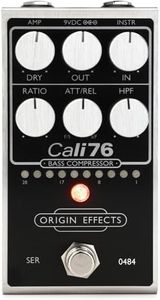
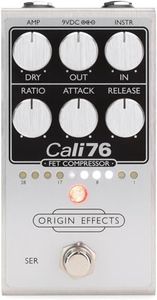
Origin Effects Cali76 Bass Compressor Pedal - Super Vintage Blue

Rating
9.4
Compression Ratio
Attack and Release
Threshold

Most important from
2 reviews

Compression Ratio
Delivers a warm, musical compression that perfectly smooths bass tones without sounding squashed.
Attack and Release
Attack and release controls allow shaping the compressor response to preserve the natural feel and add a nice ‘pop’ to the sound.
Threshold
Input knob cleverly combines threshold and input gain adjustments, boosting volume as compression increases for great live performance control.
Sustain
Enhances sustain and presence without harshness, making it ideal for bassists seeking vintage-style compression with intuitive operation.

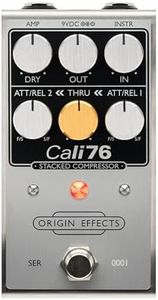
The Origin Effects Cali76 Bass Compressor Pedal in Super Vintage Blue is designed specifically for electric bass players seeking smooth and vintage-style compression. It uses FET technology, which is known for providing a warm, musical compression that helps even out your playing without sounding too squashed. Key controls include attack and release, letting you shape how quickly the compressor responds and recovers, which is important for maintaining the natural feel of your bass tone. The pedal also features a blend control, allowing you to mix the compressed and dry signals to preserve dynamics and clarity — a handy feature for bassists who want punch without losing the original character of their instrument.

One standout feature is the sidechain high-pass filter (HPF), which helps avoid over-compressing low-frequency notes, keeping the bottom end tight and clear. While the pedal doesn’t have traditional controls like threshold or compression ratio on the surface, its design indicates these parameters are set internally to achieve that classic '76-style compression. The pedal is housed in a sturdy metal case, uses true bypass switching to keep your tone pure when off, and runs on standard 9V power.

This pedal is ideal for players wanting a reliable, vintage-style compressor with intuitive controls, solid build quality, and a musical tone that enhances sustain and presence without harshness. It may feel less suitable for those needing precise, numeric control over every compression setting or looking for a budget-friendly option, as it emphasizes a specific vintage vibe and carries a higher price point and weight.

Rating
9.4
Compression Ratio
Attack and Release
Threshold

Most important from
2 reviews

Compression Ratio
Delivers a warm, musical compression that perfectly smooths bass tones without sounding squashed.
Attack and Release
Attack and release controls allow shaping the compressor response to preserve the natural feel and add a nice ‘pop’ to the sound.
Threshold
Input knob cleverly combines threshold and input gain adjustments, boosting volume as compression increases for great live performance control.
Sustain
Enhances sustain and presence without harshness, making it ideal for bassists seeking vintage-style compression with intuitive operation.
#3

Boss CS-3 Compressor/Sustainer Pedal

Rating
8.8
Sustain

Most important from
1330 reviews

Sustain
Offers sweet sustain with no audible distortion, making it a true compressor/sustain pedal.

The Boss CS-3 Compressor/Sustainer Pedal is a popular choice for guitarists looking to enhance their sound with compression while maintaining a low-noise operation. One of its standout features is the range of controls it offers, including Level, Tone, Attack, and Sustain. This allows players to fine-tune their tone to suit various musical styles, making it versatile for different genres, including world music. The pedal's True Bypass design is another strength, ensuring that when it's off, it doesn't affect your guitar’s natural tone.

However, there are a few drawbacks to consider. While the pedal is well-regarded, beginners might find the range of settings a bit overwhelming when starting out. Additionally, some users report that achieving a specific compression sound can take some trial and error, which might be frustrating for those who want an easier plug-and-play experience. The Boss CS-3, while effective, is also noted to be slightly less transparent than some higher-end models, which may not appeal to purists seeking the most natural sound.

The Boss CS-3 is a solid choice for guitarists who want a reliable compressor with extensive tonal control. It's particularly suited for those willing to experiment and find their desired sounds, but might be slightly challenging for complete beginners. It is a well-rounded pedal that has earned its place among essential guitar accessories.

Rating
8.8
Sustain

Most important from
1330 reviews

Sustain
Offers sweet sustain with no audible distortion, making it a true compressor/sustain pedal.

Buying Guide for the Best Compressor Pedals

Choosing the right compressor pedal for your guitar can significantly enhance your sound by evening out the dynamics and adding sustain. A compressor pedal can help you achieve a more polished and professional tone, whether you're playing live or recording in the studio. To find the best fit for you, it's important to understand the key specifications and how they align with your playing style and needs.
Compression RatioThe compression ratio determines how much the signal is compressed. A higher ratio means more compression, which can smooth out your playing and add sustain, but too much can squash your tone. Ratios typically range from 2:1 to 10:1. For subtle compression, a lower ratio (2:1 to 4:1) is ideal, while higher ratios (5:1 to 10:1) are better for more pronounced effects. Choose a ratio based on how much you want to control your dynamics.
Attack and ReleaseAttack and release settings control how quickly the compressor responds to your playing. Attack is the time it takes for the compressor to kick in after a note is played, and release is how long it takes to stop compressing after the note ends. Fast attack times can catch quick peaks, while slower attack times let more of the initial note through. Similarly, fast release times can make the compression more noticeable, while slower release times provide a smoother sound. Adjust these settings based on whether you want a more transparent or a more pronounced compression effect.
ThresholdThe threshold is the level at which the compressor starts to work. Signals above this level are compressed, while those below it are unaffected. A lower threshold means more of your signal will be compressed, which can be useful for evening out your playing. A higher threshold will only compress the loudest parts of your signal, preserving more of your natural dynamics. Choose a threshold setting based on how much of your playing you want to be affected by the compression.
SustainSustain controls how long the notes are held after being played. More sustain can make your notes ring out longer, which is great for solos and lead playing. Less sustain will give you a more natural decay. If you play a lot of lead guitar or want your notes to sing, look for a pedal with a good sustain feature. If you prefer a more natural sound, less sustain might be better.
Tone ControlSome compressor pedals come with a tone control, which allows you to adjust the brightness or darkness of your compressed signal. This can help you maintain clarity and presence in your sound, especially if the compression is affecting your tone. If you find that compression is dulling your sound, a tone control can help you dial back in some of the lost frequencies. Choose a pedal with tone control if you want more flexibility in shaping your sound.
True BypassTrue bypass means that when the pedal is turned off, your signal passes through without any alteration. This is important for maintaining the integrity of your tone when the pedal is not in use. If you have a lot of pedals in your signal chain, true bypass can help prevent tone loss. Look for a compressor pedal with true bypass if you want to ensure your signal remains clean and unaltered when the pedal is off.

FAQ

Most Popular Categories Right Now