We Use CookiesWe use cookies to enhance the security, performance, functionality and for analytical and promotional activities. By continuing to browse this site you are agreeing to our privacy policy

10 Best Home Generators 2026 in the United States
How do we rank products for you?

Our technology thoroughly searches through the online shopping world, reviewing hundreds of sites. We then process and analyze this information, updating in real-time to bring you the latest top-rated products. This way, you always get the best and most current options available.

headphones-stars

Our Top Picks

#1

Winner

Westinghouse 11000 Peak Watt Dual Fuel Portable Inverter Generator, Remote Electric Start, Transfer Switch Ready, Gas and Propane Powered, Low THD - Safe for Electronics, Parallel Capable, CO Sensor

Rating
10.0
Chosen by1,246
Power Output (Wattage)
Fuel Type
Runtime

Most important from
1164 reviews

Power Output (Wattage)
Runs flawlessly for days, handling all home appliances including heating units.
Fuel Type
Easy to wire up and connect to natural gas or propane lines, enhancing convenience.
Runtime
Dual fuel capability makes keeping it fueled easy, with propane lasting 9 hours and gas 12 hours.
Portability
Assembly is straightforward and moving the generator is manageable with built-in handles.
Noise Level
Although noisier than some other brands, it is solid and built to last.
Start Type
Remote key fob allows starting and stopping the generator without going outside, perfect for storm prep.

The Westinghouse 11000 Peak Watt Dual Fuel Portable Inverter Generator is a robust choice for those needing a reliable home generator. With a high power output of 9000 running watts (gasoline) and 8100 running watts (propane), it can handle most home appliances and electronics safely due to its low THD (Total Harmonic Distortion) of less than 3%. The dual fuel capability is a significant advantage, allowing flexibility between gasoline and propane. Its runtime is impressive, offering up to 17 hours on a 9.8-gallon tank, making it suitable for prolonged use during power outages.

The remote electric start feature, alongside push-button and recoil options, adds convenience, ensuring easy operation even in emergencies. The generator includes various safety features like a CO sensor and automatic low oil shutdown, enhancing its safety profile. Equipped with multiple outlets, including transfer switch-ready options, it is versatile for different power needs. However, its weight of 187.4 pounds may pose a challenge for portability despite being labeled as portable.

Minimal assembly is required, and it comes with essential components like an oil bottle, funnel, and propane regulator. This generator is backed by a 3-year limited service warranty and a nationwide customer service network, offering peace of mind. Users who prioritize power output, fuel flexibility, and runtime may find this generator particularly beneficial.

Rating
10.0
Chosen by1,246
Power Output (Wattage)
Fuel Type
Runtime

Most important from
1164 reviews

Power Output (Wattage)
Runs flawlessly for days, handling all home appliances including heating units.
Fuel Type
Easy to wire up and connect to natural gas or propane lines, enhancing convenience.
Runtime
Dual fuel capability makes keeping it fueled easy, with propane lasting 9 hours and gas 12 hours.
Portability
Assembly is straightforward and moving the generator is manageable with built-in handles.
Noise Level
Although noisier than some other brands, it is solid and built to last.
Start Type
Remote key fob allows starting and stopping the generator without going outside, perfect for storm prep.
#2

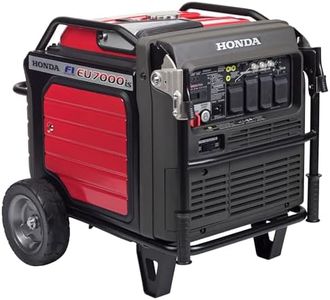
Honda EU7000IS 7,000 Watt Inverter Portable Backup Generator, Super Quiet, Electric Start

Rating
10.0
Power Output (Wattage)
Noise Level

Most important from
24 reviews

Power Output (Wattage)
Outputs measured steady at 122VAC/244VAC, indicating reliable power delivery.
Noise Level
The engine started immediately and runs much quieter than older models, which is a huge improvement.

The Honda EU7000IS is positioned as a versatile home generator, ideal for backup power during outages, RV use, and outdoor events. With a power output of 7,000 watts, it can handle most household appliances, making it a reliable choice for residential needs. One of its standout features is the super quiet operation, which can be a game changer for those concerned about noise—particularly in neighborhoods where loud generators can be disruptive. Its fuel efficiency also means you won't have to refuel it constantly, enhancing its practicality during extended use.

Portability is enhanced by its design, although at 270 pounds, it may require effort to move around without assistance. The electric start feature adds convenience, sparing you the hassle of manual starting. Furthermore, the inclusion of the Honda My Generator app with Bluetooth capability provides modern users with easy monitoring and control, which is a nice touch for tech-savvy customers.

On the safety side, the CO-MINDER carbon monoxide detection system offers peace of mind, ensuring that the generator operates safely in your vicinity. The 3-year residential warranty further underscores Honda's commitment to quality and customer satisfaction.

Rating
10.0
Power Output (Wattage)
Noise Level

Most important from
24 reviews

Power Output (Wattage)
Outputs measured steady at 122VAC/244VAC, indicating reliable power delivery.
Noise Level
The engine started immediately and runs much quieter than older models, which is a huge improvement.
#3

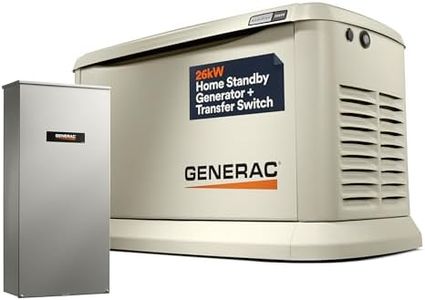
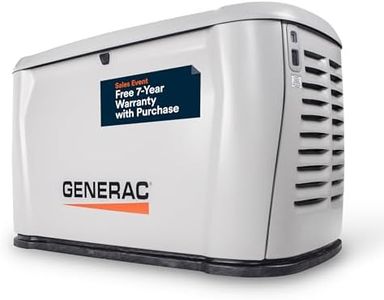
Generac Guardian 26kW Home Standby Generator with 200 Amp Transfer Switch - Automatic Whole House Backup Power for Storms, Emergencies, and Outages, WiFi Enabled, Runs on Natural Gas or Liquid Propane

Rating
9.7
Power Output (Wattage)
Fuel Type
Runtime

Most important from
421 reviews

Power Output (Wattage)
Delivers reliable whole-house backup power that activates automatically within seconds of an outage.
Fuel Type
Fuel flexibility with natural gas or propane adds convenience and accessibility for homeowners.
Runtime
Runs smoothly and quietly, providing seamless electricity to the entire home during extended power interruptions.
Portability
Installation requires a licensed electrician, reflecting its design as a permanent, low-maintenance solution rather than a portable unit.
Noise Level
Runs smoothly and quietly, providing seamless electricity to the entire home during extended power interruptions.
Start Type
Overall, a solid investment that performs flawlessly during outages, justifying the cost with dependable operation and automatic start/stop functionality.

The Generac Guardian 26kW Home Standby Generator is a solid choice for homeowners looking for reliable whole-house backup power. Its 26,000-watt output is strong enough to keep most household appliances and systems running smoothly during an outage. It runs on natural gas or propane, which are common and convenient fuel options for home standby generators. The generator features an automatic electronic start, meaning it turns on by itself when power goes out, so you don't have to worry about manual operation.

One of the standout features is its Wi-Fi connectivity, allowing you to monitor the generator remotely and receive maintenance alerts, which adds convenience and peace of mind. The unit is built with a durable aluminum casing and includes a 200 Amp transfer switch that integrates the generator seamlessly with your home's electrical system.

The generator is described as super quiet and low maintenance, but it weighs over 500 pounds and is not portable; it's designed to be permanently installed outside your home. Installation should be done by a licensed electrician, which is typical for this type of equipment. This generator is well suited for homeowners wanting dependable and automatic backup power for their entire house, especially if remote monitoring and quieter operation are important to them. Its size, weight, and need for professional installation mean it is not a portable or DIY-friendly option.

Rating
9.7
Power Output (Wattage)
Fuel Type
Runtime

Most important from
421 reviews

Power Output (Wattage)
Delivers reliable whole-house backup power that activates automatically within seconds of an outage.
Fuel Type
Fuel flexibility with natural gas or propane adds convenience and accessibility for homeowners.
Runtime
Runs smoothly and quietly, providing seamless electricity to the entire home during extended power interruptions.
Portability
Installation requires a licensed electrician, reflecting its design as a permanent, low-maintenance solution rather than a portable unit.
Noise Level
Runs smoothly and quietly, providing seamless electricity to the entire home during extended power interruptions.
Start Type
Overall, a solid investment that performs flawlessly during outages, justifying the cost with dependable operation and automatic start/stop functionality.

Buying Guide for the Best Home Generators

Choosing the right home generator is crucial to ensure you have a reliable power source during outages. The right generator can keep your essential appliances running, provide comfort, and ensure safety. To make an informed decision, you need to understand the key specifications and how they align with your needs. Here are the main factors to consider when selecting a home generator.
Power Output (Wattage)Power output, measured in watts, indicates how much electricity the generator can produce. This is important because it determines how many and what type of appliances you can run simultaneously. Generators typically range from 1,000 watts to over 20,000 watts. For basic needs like lights, a refrigerator, and a few small appliances, a generator with 3,000 to 5,000 watts may suffice. For whole-house coverage, especially if you have high-power appliances like air conditioners or electric stoves, you might need 10,000 watts or more. Assess your power needs by listing essential devices and their wattage requirements.
Fuel TypeGenerators can run on various fuels, including gasoline, propane, natural gas, and diesel. The fuel type affects the generator's runtime, availability, and storage. Gasoline is widely available but has a shorter shelf life and can be harder to store in large quantities. Propane has a longer shelf life and burns cleaner but requires a storage tank. Natural gas offers a continuous supply if you have a gas line but may not be available in all areas. Diesel is efficient and has a long shelf life but can be more expensive and less environmentally friendly. Choose a fuel type based on availability, storage convenience, and your environmental preferences.
RuntimeRuntime refers to how long a generator can operate on a full tank of fuel. This is important for planning how often you will need to refuel during an outage. Generators with larger fuel tanks or more efficient engines will have longer runtimes. For example, a generator with a 5-gallon tank might run for 8-10 hours at 50% load. If you need continuous power for extended periods, look for generators with longer runtimes or consider models that can be connected to larger external fuel sources. Match the runtime to your expected outage duration and refueling capabilities.
PortabilityPortability refers to how easy it is to move the generator. This is important if you need to transport the generator to different locations or store it when not in use. Portable generators typically have wheels and handles, making them easier to move. They are ideal for temporary power needs or if you plan to use the generator in multiple locations. Stationary or standby generators are permanently installed and automatically turn on during an outage. They are more powerful and convenient for whole-house coverage but are not portable. Choose based on whether you need a fixed or mobile power solution.
Noise LevelNoise level, measured in decibels (dB), indicates how loud the generator will be during operation. This is important for comfort and compliance with local noise regulations. Generators can range from 50 dB (similar to a quiet conversation) to over 100 dB (similar to a chainsaw). If you live in a densely populated area or plan to use the generator near living spaces, look for models with lower noise levels, typically under 70 dB. For remote or less noise-sensitive areas, higher noise levels may be acceptable. Consider your environment and tolerance for noise when choosing a generator.
Start TypeStart type refers to how the generator is turned on. Common options include manual recoil start, electric start, and automatic start. Manual recoil start requires pulling a cord, which can be physically demanding. Electric start uses a battery to start the generator with the push of a button, offering convenience and ease of use. Automatic start is typically found in standby generators and activates the generator automatically during a power outage. Choose a start type based on your physical ability, convenience preference, and whether you need the generator to start automatically during an outage.

FAQ

Most Popular Categories Right Now