We Use CookiesWe use cookies to enhance the security, performance, functionality and for analytical and promotional activities. By continuing to browse this site you are agreeing to our privacy policy

10 Best Label Maker Printers 2026 in the United States
How do we rank products for you?

Our technology thoroughly searches through the online shopping world, reviewing hundreds of sites. We then process and analyze this information, updating in real-time to bring you the latest top-rated products. This way, you always get the best and most current options available.

headphones-stars

Our Top Picks

#1

Winner

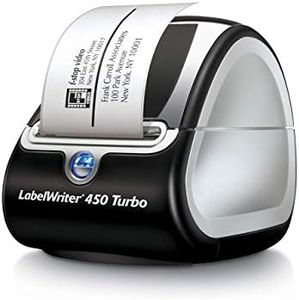
DYMO Label Printer | LabelWriter 450 Turbo Direct Thermal Label Printer, Fast Printing, Great for Labeling, Filing, Shipping, Mailing, Barcodes and More, Home & Office Organization (Renewed)

Rating
10.0
Chosen by1,167
Print Speed
Durability and Build Quality

Most important from
63 reviews

Print Speed
The printer delivers fast, no-fuss label printing that suits busy environments like hospitals and offices.
Durability and Build Quality
This label printer is compact and fits perfectly on a desk, making it ideal for office use.

The DYMO LabelWriter 450 Turbo is a solid choice for home or office users who need fast, reliable label printing without the mess or expense of ink cartridges. It prints at a resolution of 203 dpi, which is good enough for clear text and barcodes. Its speed is impressive, producing up to 71 labels per minute, making it suitable for bulk labeling tasks like shipping or filing. It uses direct thermal printing, so you won’t have to worry about replacing ink, which keeps running costs low. The maximum label width is about 2.3 inches, fitting most common label sizes for address, shipping, and name badges.

Connectivity is via USB only, so it’s easy to set up with most computers but lacks wireless options. Software compatibility includes popular programs like Microsoft Word, Excel, Outlook, and Google Contacts, allowing straightforward label creation and printing. Since it runs on direct USB power, there is no need for separate power adapters, which simplifies use. The build quality is decent for a renewed device, offering durability for regular office use, though it comes with a limited 90-day warranty. This product is ideal for users who want a fast, no-fuss labeling solution primarily at a desk, but it might not suit those needing wireless printing or very wide labels.

Rating
10.0
Chosen by1,167
Print Speed
Durability and Build Quality

Most important from
63 reviews

Print Speed
The printer delivers fast, no-fuss label printing that suits busy environments like hospitals and offices.
Durability and Build Quality
This label printer is compact and fits perfectly on a desk, making it ideal for office use.
#2

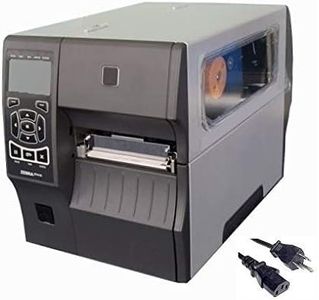
Zebra ZT410 Barcode Label Printer | Thermal Transfer & Direct | Industrial, 4-Inch, 203dpi, USB and Ethernet Interfaces, Power Cable (Renewed)

Rating
8.8
Durability and Build Quality

Most important from
11 reviews

Durability and Build Quality
The printer arrived damaged multiple times, indicating concerns with product handling or quality control.

The Zebra ZT410 is an industrial-grade label printer designed for office and light industrial use, capable of printing 4-inch wide labels with a 203 dpi resolution. This print quality is sufficient for clear barcode and text labels, though it is not the sharpest on the market if you need very fine detail. It supports both thermal transfer and direct thermal printing, which offers flexibility depending on your label durability requirements.

Connectivity includes USB and Ethernet, making it easy to integrate into various setups, especially in networked office environments. However, it only has one USB and one Ethernet port, so options for multiple connections are limited. The printer is built with durability in mind, featuring a robust design suitable for frequent use. It operates via a simple touch control method. The printer runs on standard power cables without battery options, so it’s best suited for stationary use.

The ZT410 meets basic industrial labeling needs and offers solid build quality, but you might want to consider if the 203 dpi resolution and limited connectivity meet your specific workflow demands.

Rating
8.8
Durability and Build Quality

Most important from
11 reviews

Durability and Build Quality
The printer arrived damaged multiple times, indicating concerns with product handling or quality control.
#3

Brady S3100 Sign and Label Printer with Workstation Safety and Facility ID Software - Prints Industrial Labels and Facility Signs (S3100-W)

Rating
7.9
Print Resolution
Print Speed
Connectivity Options

Most important from
8 reviews

Print Resolution
The printer delivers sharp, durable labels that meet demanding industrial labeling needs with ease.
Print Speed
The print speed is moderate but suitable for detailed, high-quality labels rather than fast bulk printing.
Connectivity Options
Lack of wireless connectivity limits flexibility, making it primarily a USB-dependent device for desktop use.
Software Compatibility
Automatic label setup simplifies operation by eliminating manual calibration hassles.
Durability and Build Quality
Its robust, heavy-duty construction feels reliable and built for tough environments.

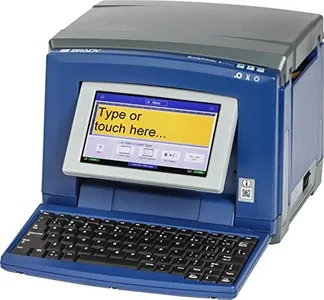
The Brady S3100 Sign and Label Printer is designed mainly for industrial and facility labeling needs, making it a solid choice if you require clear, durable labels for wires, panels, and other equipment. It prints at a respectable 300 dpi resolution, ensuring text and symbols come out sharp and easy to read. The thermal transfer technology helps produce long-lasting prints suitable for harsh environments. While its print speed is modest at about 3 inches per second, this is typical for detailed industrial labels rather than high-volume, fast printing.

Label width support up to 4.25 inches gives you flexibility for various label sizes, and the included cutter options add convenience by allowing clean cuts at the end or between labels. One standout feature is the automatic label setup, which saves time by eliminating manual calibration and sensor adjustments—great if you want straightforward operation without fuss. The printer connects via USB, so it’s simple to link with a PC, but lacks wireless options which might be a drawback if you prefer network printing or mobile device compatibility. The package includes helpful extras like a cleaning kit and stylus, supporting maintenance and ease of use.

Physically, the unit is a bit heavy and bulky for a desktop device, reflecting its robust build quality meant for industrial settings rather than casual or portable use. It’s compatible with Brady’s B30 continuous tapes, which offers a range of label styles and widths fitting diverse identification needs. This printer is ideal for workplaces focused on safety and facility management where reliable, easy-to-read labeling is critical, rather than users needing rapid, high-volume printing or wireless connectivity.

Rating
7.9
Print Resolution
Print Speed
Connectivity Options

Most important from
8 reviews

Print Resolution
The printer delivers sharp, durable labels that meet demanding industrial labeling needs with ease.
Print Speed
The print speed is moderate but suitable for detailed, high-quality labels rather than fast bulk printing.
Connectivity Options
Lack of wireless connectivity limits flexibility, making it primarily a USB-dependent device for desktop use.
Software Compatibility
Automatic label setup simplifies operation by eliminating manual calibration hassles.
Durability and Build Quality
Its robust, heavy-duty construction feels reliable and built for tough environments.

Buying Guide for the Best Label Maker Printers

Choosing the right label maker printer can make your labeling tasks much easier and more efficient. Whether you need it for home organization, office use, or industrial purposes, understanding the key specifications will help you select the best model for your needs. Here are the main factors to consider when picking a label maker printer.
Print ResolutionPrint resolution refers to the clarity and detail of the printed labels, measured in dots per inch (DPI). Higher DPI means sharper and more detailed labels. For basic home or office use, a resolution of 200-300 DPI is usually sufficient. For professional or industrial use where fine details are important, such as barcodes or small text, look for a printer with 300 DPI or higher. Consider your specific needs: if you require high-quality, detailed labels, opt for a higher DPI.
Print SpeedPrint speed indicates how quickly the label maker can produce labels, usually measured in millimeters per second (mm/s). Faster print speeds are beneficial for high-volume tasks, saving you time. For occasional home use, a lower speed may be acceptable, but for busy office environments or industrial settings, a higher speed (e.g., 30-60 mm/s or more) will be more efficient. Assess how frequently and quickly you need to produce labels to determine the appropriate print speed for your needs.
Label WidthLabel width refers to the maximum width of the labels the printer can handle. Common widths range from 1/4 inch to 4 inches or more. For general home or office use, a standard width of 1/2 inch to 1 inch is often sufficient. For specialized tasks, such as shipping labels or large organizational labels, you may need a printer that supports wider labels. Consider the types of labels you need to print and choose a printer that accommodates those widths.
Connectivity OptionsConnectivity options determine how you can connect the label maker to your devices. Common options include USB, Bluetooth, and Wi-Fi. USB connections are reliable for direct connections to a computer. Bluetooth and Wi-Fi offer wireless convenience, allowing you to print from smartphones, tablets, or multiple computers. If you need flexibility and ease of use, especially in a shared office environment, look for a printer with wireless connectivity. Choose based on how you plan to use the printer and the devices you will connect to it.
Software CompatibilitySoftware compatibility refers to the label design software that works with the printer. Some label makers come with their own software, while others are compatible with third-party applications. Ensure the software is user-friendly and offers the features you need, such as templates, barcode generation, and customization options. If you have specific software preferences or requirements, check compatibility before purchasing. Choose a printer with software that meets your design and functionality needs.
Power SourceThe power source for label makers can vary, including options like batteries, rechargeable batteries, or AC adapters. Battery-operated models offer portability, making them ideal for on-the-go use or in locations without easy access to power outlets. AC-powered models are better for stationary use, providing consistent power without the need to replace or recharge batteries. Consider where and how you will use the label maker to determine the best power source for your situation.
Durability and Build QualityDurability and build quality are important for ensuring the label maker can withstand regular use, especially in demanding environments. Look for models with sturdy construction and high-quality materials. For industrial or heavy-duty use, choose a label maker designed to handle rough conditions and frequent use. For home or light office use, a less rugged model may suffice. Assess the environment and frequency of use to select a label maker with appropriate durability.

FAQ

Most Popular Categories Right Now