We Use CookiesWe use cookies to enhance the security, performance, functionality and for analytical and promotional activities. By continuing to browse this site you are agreeing to our privacy policy

10 Best Long Range TV Antennas 2026 in the United States
How do we rank products for you?

Our technology thoroughly searches through the online shopping world, reviewing hundreds of sites. We then process and analyze this information, updating in real-time to bring you the latest top-rated products. This way, you always get the best and most current options available.

headphones-stars

Our Top Picks

#1

Winner

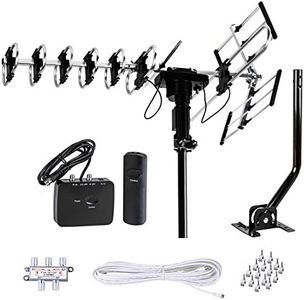
Channel Master CM-5020 Directional Outdoor TV Antenna 100 Mile Range Masterpiece Series

Rating
10.0
Chosen by1,102
Range
Frequency Bands
Installation and Mounting

Most important from
431 reviews

Range
Picks up stations 80+ miles away with clarity.
Frequency Bands
UHF reception does not match specialized UHF antennas, but overall performance is solid.
Installation and Mounting
Installation is straightforward and can be done with minimal effort.
Weather Resistance
Heavy duty build, designed to survive all weather conditions.

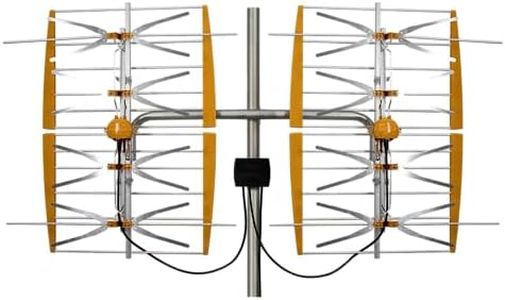
The Channel Master CM-5020 Directional Outdoor TV Antenna is a solid choice for those seeking a long-range TV antenna with a range of up to 100 miles. It operates on both VHF and UHF frequency bands, offering a gain of 10dB for VHF and 16dB for UHF, which helps in receiving clearer signals. As a directional antenna, it is designed to pick up signals from a specific direction, making it ideal for rural areas where broadcast towers are far apart.

The antenna's front-to-back ratio of 17dB further enhances its ability to minimize interference from other directions. Installation is straightforward with a U-bolt mounting clamp that fits poles up to 2.5 inches in diameter. The antenna's wind resistance rating of 30 pounds at 100 mph ensures it can withstand harsh weather conditions, making it a durable option for outdoor use.

However, its large size (116 x 101.5 x 20 inches) and weight (11.5 pounds) might require a sturdy mounting structure and assistance during installation. Another consideration is the 6-foot turning radius, which might need ample space for optimal positioning. This product is well-suited for users in remote or rural locations who need a reliable long-range antenna that can handle various weather conditions.

Rating
10.0
Chosen by1,102
Range
Frequency Bands
Installation and Mounting

Most important from
431 reviews

Range
Picks up stations 80+ miles away with clarity.
Frequency Bands
UHF reception does not match specialized UHF antennas, but overall performance is solid.
Installation and Mounting
Installation is straightforward and can be done with minimal effort.
Weather Resistance
Heavy duty build, designed to survive all weather conditions.
#2

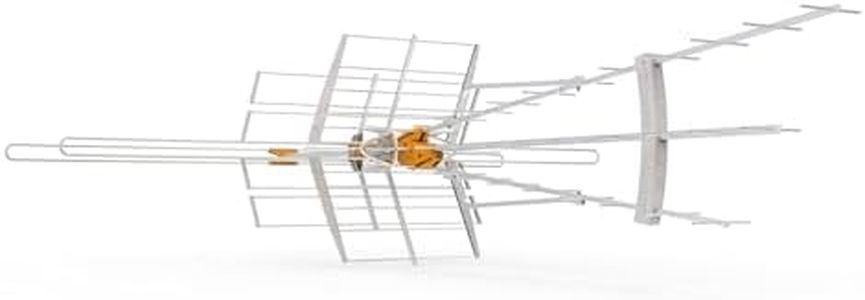
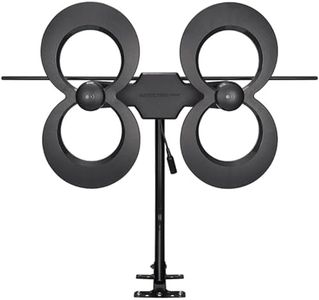
Antennas Direct ClearStream MAX-V PRO Indoor Outdoor TV Antenna, UHF VHF, Multi-Directional, 70+ Mile Range, 4K 8K UHD, NEXTGEN TV – w/Wall Bracket

Rating
8.8
Range
Frequency Bands
Gain

Most important from
86 reviews

Range
Reception is significantly improved compared to previous antennas, with strong signal quality even for distant stations up to around 57 miles away.
Frequency Bands
The antenna performs well with both UHF and VHF high band signals, though UHF gain is notably higher, providing reliable access to a wide range of channels.
Gain
An amplifier is recommended for optimal reception, especially for weaker or more distant channels, and should ideally be placed close to the antenna.
Directional vs. Multi-directional
The bi-directional design excels at capturing signals from multiple directions, making it ideal for locations between two broadcast markets without needing constant repositioning.
Installation and Mounting
Installation is straightforward and the antenna’s moderate size and modern design make it suitable for mounting indoors or outdoors without being obtrusive.
Weather Resistance
Durable, corrosion-resistant plastic construction helps the antenna withstand harsh weather conditions, though some concerns remain about the long-term durability of connectors and mounting hardware in extreme environments.

The Antennas Direct ClearStream MAX-V PRO is a strong choice for those needing a long-range TV antenna, with a claimed range of over 70 miles, which suits suburban and rural users far from broadcast towers. This antenna supports both UHF and VHF frequency bands, covering a wide array of TV channels, including newer standards like NEXTGEN TV, 4K, and 8K UHD. Its multi-directional design using four patented loops means it can pick up signals from multiple directions without needing to be constantly repositioned, which is handy if you have TV towers spread out or plan to move the antenna occasionally.

Installation is flexible: you can mount it indoors, in an attic, or outdoors on a mast or wall, with the included sturdy steel bracket and mounting hardware. The materials are durable and weather-resistant, so it should hold up well to outdoor conditions. The antenna size is moderate, and while it requires some assembly, it’s designed to be user-friendly.

Signal quality can be affected by obstacles such as trees and building materials, so results may vary depending on your specific location. The 75 Ohm impedance is standard and should work with most TV setups, but make sure your equipment is compatible. At about 2.7 pounds, it’s lightweight enough not to need a heavy-duty mount, but it’s still sizable. With a solid 4.3 out of 5 rating from users and a lifetime warranty, this antenna offers dependable performance for free HDTV signals without internet. If you want a long-range antenna that covers multiple frequency bands and is adaptable to different mounting needs, the ClearStream MAX-V PRO is worth considering.

Rating
8.8
Range
Frequency Bands
Gain

Most important from
86 reviews

Range
Reception is significantly improved compared to previous antennas, with strong signal quality even for distant stations up to around 57 miles away.
Frequency Bands
The antenna performs well with both UHF and VHF high band signals, though UHF gain is notably higher, providing reliable access to a wide range of channels.
Gain
An amplifier is recommended for optimal reception, especially for weaker or more distant channels, and should ideally be placed close to the antenna.
Directional vs. Multi-directional
The bi-directional design excels at capturing signals from multiple directions, making it ideal for locations between two broadcast markets without needing constant repositioning.
Installation and Mounting
Installation is straightforward and the antenna’s moderate size and modern design make it suitable for mounting indoors or outdoors without being obtrusive.
Weather Resistance
Durable, corrosion-resistant plastic construction helps the antenna withstand harsh weather conditions, though some concerns remain about the long-term durability of connectors and mounting hardware in extreme environments.
#3

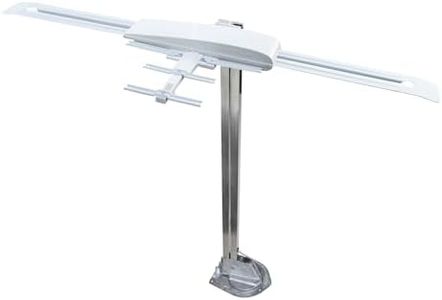
Winegard RVW-395 Sensar IV White DTV/HD TV Antenna

Rating
8.8
Range
Installation and Mounting
Weather Resistance

Most important from
1085 reviews

Range
This antenna delivers a dramatic improvement in signal strength and quality, turning previously spotty reception into solid, reliable HD signals.
Installation and Mounting
Installation is straightforward and quick, particularly as an upgrade replacement, making it easy to swap out older models.
Weather Resistance
The build quality feels solid with metal and plastic components working smoothly, especially the gear mechanism for raising and lowering the antenna.

The Winegard RVW-395 Sensar IV is a long-range TV antenna designed to pick up digital TV signals from up to 55 miles away, making it a solid choice for those living in suburban or rural areas where broadcast towers can be far. It works well with both VHF and UHF frequency bands, so it can receive a wide variety of local channels, including popular networks like ABC, CBS, NBC, and FOX, plus many sub-channels that satellite providers might not offer.

This antenna is a low-profile, directional type, meaning it needs to be aimed towards the broadcast towers to get the best signal, which can be a bit less convenient than antennas that pick up signals from all directions. However, its design allows it to fold down to just 4 inches high when traveling, which is great for protecting it from damage like tree branches or wires. The powder-coated finish adds durability and helps it withstand different weather conditions, so it should hold up well outdoors.

Installation is straightforward and fits universally on most setups, although it’s a bit larger and heavier than some indoor antennas, so it’s best suited for outdoor mounting on rooftops or RVs. It doesn’t have the highest gain compared to some professional-grade models but balances performance and durability to deliver reliable HD and SD signals for local TV without monthly fees. For those seeking a sturdy, weather-resistant antenna with good range for local channels and who don’t mind adjusting its direction for optimal reception, the Winegard RVW-395 is a dependable option.

Rating
8.8
Range
Installation and Mounting
Weather Resistance

Most important from
1085 reviews

Range
This antenna delivers a dramatic improvement in signal strength and quality, turning previously spotty reception into solid, reliable HD signals.
Installation and Mounting
Installation is straightforward and quick, particularly as an upgrade replacement, making it easy to swap out older models.
Weather Resistance
The build quality feels solid with metal and plastic components working smoothly, especially the gear mechanism for raising and lowering the antenna.

Buying Guide for the Best Long Range TV Antennas

Choosing the right long-range TV antenna can significantly improve your television viewing experience, especially if you live in a rural or remote area. The key is to understand the specifications that matter most and how they align with your needs. Here are the essential specs to consider when selecting a long-range TV antenna.
RangeThe range of a TV antenna indicates how far it can receive signals from broadcast towers. This is crucial because it determines whether you can access channels that are far away from your location. Antennas typically range from 50 miles to over 150 miles. If you live in a rural area, you might need an antenna with a longer range, while urban dwellers can often get by with a shorter range due to the proximity of broadcast towers.
Frequency BandsTV antennas can receive signals in different frequency bands, mainly VHF (Very High Frequency) and UHF (Ultra High Frequency). VHF channels are typically lower in number and can travel longer distances, while UHF channels are higher in number and often provide better picture quality. It's important to choose an antenna that supports both VHF and UHF bands to ensure you can access all available channels in your area.
Antenna TypeThere are various types of TV antennas, including indoor, outdoor, and attic-mounted. Outdoor antennas generally offer better reception and longer range compared to indoor antennas. If you live far from broadcast towers, an outdoor antenna might be necessary. However, if you live closer to the towers or in an apartment, an indoor antenna could suffice.
GainGain refers to the antenna's ability to amplify the signal it receives. Higher gain antennas can pick up weaker signals, which is particularly useful if you are far from broadcast towers. Gain is measured in decibels (dB), and antennas with higher dB ratings can provide better reception. If you experience weak signals, look for an antenna with higher gain.
Directional vs. Multi-directionalDirectional antennas focus on signals from one direction, which can be beneficial if all broadcast towers are located in the same area. Multi-directional antennas can receive signals from multiple directions, making them ideal if towers are scattered around your location. Consider the layout of broadcast towers in your area to decide which type suits you best.
Installation and MountingThe ease of installation and mounting options can affect your choice. Some antennas come with mounting hardware and are easier to install, while others might require professional installation. Consider your comfort level with DIY projects and the physical space available for mounting the antenna.
Weather ResistanceIf you opt for an outdoor antenna, weather resistance is an important factor. Antennas exposed to the elements need to withstand rain, wind, and extreme temperatures. Look for antennas made from durable materials and with weatherproof features to ensure longevity and consistent performance.

FAQ

Most Popular Categories Right Now