We Use CookiesWe use cookies to enhance the security, performance, functionality and for analytical and promotional activities. By continuing to browse this site you are agreeing to our privacy policy

10 Best Monitor For Video Editing 2026 in the United States
How do we rank products for you?

Our technology thoroughly searches through the online shopping world, reviewing hundreds of sites. We then process and analyze this information, updating in real-time to bring you the latest top-rated products. This way, you always get the best and most current options available.

headphones-stars

Our Top Picks

#1

Winner

ASUS ProArt Display 32” 6K Professional Monitor (PA32QCV) - IPS, 6K (6016 x 3384), 98% DCI-P3, LuxPixel™, ΔE < 2, Calman Verified, Thunderbolt 4, DisplayHDR600, DisplayWidget, 3 yr Warranty

Rating
10.0
Chosen by1,137
Color Accuracy
Resolution
Size and Aspect Ratio

Most important from
65 reviews

Color Accuracy
The monitor delivers perfect color accuracy and exceptional brightness, making it ideal for detailed illustration and print color proofing.
Resolution
Its 6K resolution and wide color gamut provide a powerhouse setup for graphic design and complex visual projects.
Size and Aspect Ratio
The companion app enhances usability, and despite its large size, the monitor is easy to manage and adjust.
Connectivity
Connectivity options, including Thunderbolt 4 with charging and daisy-chaining, are impressive and convenient for multitasking.

The ASUS ProArt Display PA32QCV is a strong contender for video editors who need a high-resolution and color-accurate monitor. Its 32-inch IPS panel offers a sharp 6K resolution (6016 x 3384), providing plenty of screen space and detail for editing high-quality video content. The IPS technology ensures wide 178-degree viewing angles, so colors and brightness stay consistent even if you’re not sitting perfectly in front of the screen. Covering 98% of the DCI-P3 color space along with 100% sRGB, it aligns well with industry standards for video production, and its factory calibration guarantees a very accurate Delta E of less than 2. This ensures the colors you see are close to how your final video will look.

Connectivity is another highlight, with dual Thunderbolt 4 ports supporting power delivery and daisy-chaining, plus HDMI 2.1 and DisplayPort 1.4 ports, making it easy to hook up multiple devices. The built-in USB hub and Auto KVM feature let you switch between two computers smoothly, which can be handy for multitasking. Brightness peaks at 600 nits and it supports DisplayHDR600, delivering good HDR performance for vibrant highlights in your footage. Ergonomically, the monitor is quite flexible with tilt, swivel, pivot, and height adjustments, helping you find a comfortable setup during long editing sessions.

This ASUS monitor offers excellent value and capabilities tailored to video editing needs for professionals or serious hobbyists focused on color precision and high detail.

Rating
10.0
Chosen by1,137
Color Accuracy
Resolution
Size and Aspect Ratio

Most important from
65 reviews

Color Accuracy
The monitor delivers perfect color accuracy and exceptional brightness, making it ideal for detailed illustration and print color proofing.
Resolution
Its 6K resolution and wide color gamut provide a powerhouse setup for graphic design and complex visual projects.
Size and Aspect Ratio
The companion app enhances usability, and despite its large size, the monitor is easy to manage and adjust.
Connectivity
Connectivity options, including Thunderbolt 4 with charging and daisy-chaining, are impressive and convenient for multitasking.
#2

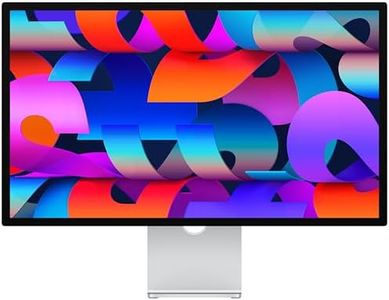
Apple Studio Display: Standard Glass, Tilt-Adjustable Stand

Rating
9.1
Resolution
Refresh Rate

Most important from
39 reviews

Resolution
The 5K Retina screen delivers incredibly sharp and vibrant visuals, making text and video editing look crisp and premium.
Refresh Rate
The 60Hz refresh rate is a noticeable limitation compared to higher refresh displays, especially for users accustomed to 120Hz or gaming monitors.

The Apple Studio Display is a high-end 27-inch 5K Retina monitor that offers exceptional resolution (5120x2880) and excellent color accuracy with support for 1 billion colors and the P3 wide color gamut. This makes it a strong choice for video editors who need precise and vibrant color representation. The 600-nit brightness helps maintain clarity even in brighter workspaces, although the default standard glass is glossy, which may produce some reflections. Apple offers a nano-texture glass option to reduce glare in challenging lighting. The display runs at a 60Hz refresh rate, which is sufficient for video editing but not designed for fast gaming.

Connectivity is modern and versatile, featuring two Thunderbolt 5 ports and two USB-C ports, allowing easy connection to Macs and other high-speed accessories, which is convenient for workflow integration. The built-in 12MP Center Stage camera and high-quality speaker and mic array add value for creators who do video calls or recordings alongside editing.

Ergonomically, it comes with a tilt-adjustable stand, but height adjustment requires purchasing an additional stand or VESA mount, which might be a downside for those needing more flexibility. While its price is on the premium side, the Studio Display excels in sharpness, color fidelity, and build quality, making it ideal for Mac users who prioritize image quality and integration over budget. If you need a monitor with more ergonomic options out of the box or a matte screen standard, you might want to consider other options.

Rating
9.1
Resolution
Refresh Rate

Most important from
39 reviews

Resolution
The 5K Retina screen delivers incredibly sharp and vibrant visuals, making text and video editing look crisp and premium.
Refresh Rate
The 60Hz refresh rate is a noticeable limitation compared to higher refresh displays, especially for users accustomed to 120Hz or gaming monitors.
#3

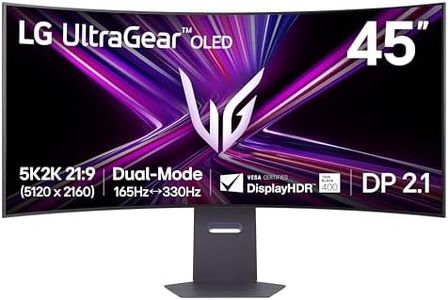
LG 45GX950A-B 45-inch Ultragear 5K2K WUHD (5120 x 2160) OLED Curved Gaming Monitor, Dual-Mode, 165Hz, 0.03ms, NVIDIA G-Sync, AMD FreeSync Premium Pro, HDR True Black 400, USB Type-C 90W, DP2.1

Rating
9.1
Resolution
Color Accuracy
Panel Type

Most important from
587 reviews

Resolution
The monitor delivers stunning color vibrancy and sharp resolution, making every detail pop whether for video editing or gaming.
Color Accuracy
The OLED panel's deep true blacks and excellent color accuracy bring subtle image nuances to life, ideal for precise color grading.
Panel Type
The OLED panel's deep true blacks and excellent color accuracy bring subtle image nuances to life, ideal for precise color grading.
Size and Aspect Ratio
The 5K2K ultrawide display provides ample workspace with crisp, fine detail that enhances both productivity and immersion.
Connectivity
Connectivity and compatibility are excellent, working seamlessly even with Linux and older GPU setups.
Refresh Rate
High refresh rates and HDR support add versatility, though the ultra-fast modes are more beneficial for gaming than editing workflows.
Ergonomics
Despite its large size and curve, the screen feels natural to view and is easier to adjust and maneuver than larger alternatives.

The LG 45GX950A-B is an impressive 45-inch ultrawide monitor that stands out with its sharp 5K2K resolution (5120 x 2160), giving video editors plenty of screen space and detail to work on wide timelines or multiple windows. Its OLED panel offers excellent color accuracy, boasting 98.5% DCI-P3 color coverage and deep true blacks, which is great for color grading and seeing subtle image details. The matte screen surface helps reduce reflections, making it easier to work in various lighting conditions.

The ultrawide 21:9 aspect ratio and 800R curve provide an immersive workspace, though the curve might take some getting used to if you prefer flat screens for editing precision. Connectivity is strong with DisplayPort 2.1, two HDMI 2.1 ports, and USB-C with 90W charging, allowing easy connection to laptops and other devices. The monitor supports a high refresh rate (up to 165Hz in 5K or 330Hz in lower resolution mode), which is more beneficial for gaming than video editing, where 60Hz is typically enough.

With 1300 nits peak brightness and HDR True Black 400 certification, the monitor supports HDR content editing effectively. This monitor is a solid choice for video editors seeking top-tier resolution, exceptional color accuracy, and a large ultrawide workspace, though the curved screen and some gaming-focused features may not be essential for all professional editing setups.

Rating
9.1
Resolution
Color Accuracy
Panel Type

Most important from
587 reviews

Resolution
The monitor delivers stunning color vibrancy and sharp resolution, making every detail pop whether for video editing or gaming.
Color Accuracy
The OLED panel's deep true blacks and excellent color accuracy bring subtle image nuances to life, ideal for precise color grading.
Panel Type
The OLED panel's deep true blacks and excellent color accuracy bring subtle image nuances to life, ideal for precise color grading.
Size and Aspect Ratio
The 5K2K ultrawide display provides ample workspace with crisp, fine detail that enhances both productivity and immersion.
Connectivity
Connectivity and compatibility are excellent, working seamlessly even with Linux and older GPU setups.
Refresh Rate
High refresh rates and HDR support add versatility, though the ultra-fast modes are more beneficial for gaming than editing workflows.
Ergonomics
Despite its large size and curve, the screen feels natural to view and is easier to adjust and maneuver than larger alternatives.

Buying Guide for the Best Monitor For Video Editing

When choosing a monitor for video editing, it's crucial to focus on specifications that will enhance your editing experience and ensure accurate color representation. A good monitor can make a significant difference in the quality of your work, so it's important to understand what to look for and how to choose the best one for your needs.
ResolutionResolution refers to the number of pixels on the screen, typically measured in width x height (e.g., 1920x1080). Higher resolution means more detail and clarity. For video editing, a higher resolution like 4K (3840x2160) is often preferred because it allows you to see more detail and work with high-definition footage more effectively. If you work with 4K content, a 4K monitor is essential. For HD content, a 1080p monitor might suffice, but higher resolutions provide better future-proofing.
Color AccuracyColor accuracy is crucial for video editing as it ensures that the colors you see on the screen are true to life. This is important for color grading and ensuring your final product looks as intended across different devices. Look for monitors with high color accuracy, often indicated by a low Delta E value (less than 2 is good). Monitors that cover a wide color gamut, such as Adobe RGB or DCI-P3, are also beneficial for professional video editing.
Panel TypeThe panel type affects the monitor's color accuracy, viewing angles, and response time. IPS (In-Plane Switching) panels are generally recommended for video editing because they offer superior color accuracy and wider viewing angles compared to TN (Twisted Nematic) panels. VA (Vertical Alignment) panels are another option, offering good color reproduction and contrast, but IPS panels are typically the best choice for professional video editing.
Size and Aspect RatioThe size of the monitor and its aspect ratio can impact your editing workflow. Larger monitors (27 inches and above) provide more screen real estate, which can be helpful for multitasking and viewing your timeline and footage simultaneously. The aspect ratio, such as 16:9 or 21:9, determines the shape of the screen. A wider aspect ratio (21:9) can be beneficial for video editing as it allows for more horizontal space, which is useful for viewing timelines and multiple windows.
ConnectivityConnectivity options determine how you can connect your monitor to your computer and other devices. Look for monitors with multiple input options like HDMI, DisplayPort, and USB-C. USB-C is particularly useful for its ability to transmit video, data, and power through a single cable. Having multiple ports allows for greater flexibility and ease of use, especially if you need to connect multiple devices.
Refresh RateRefresh rate, measured in Hertz (Hz), indicates how many times per second the screen refreshes its image. While a higher refresh rate (like 144Hz) is more important for gaming, a standard 60Hz refresh rate is typically sufficient for video editing. However, if you also plan to use the monitor for gaming or other high-motion activities, a higher refresh rate might be beneficial.
ErgonomicsErgonomics refers to the monitor's adjustability features, such as height, tilt, swivel, and pivot. These features are important for ensuring a comfortable and healthy working posture, especially during long editing sessions. A monitor with good ergonomic options allows you to adjust it to your preferred viewing position, reducing strain on your neck and eyes.

FAQ

Most Popular Categories Right Now