We Use CookiesWe use cookies to enhance the security, performance, functionality and for analytical and promotional activities. By continuing to browse this site you are agreeing to our privacy policy

10 Best Ryzen Motherboard 2026 in the United States
How do we rank products for you?

Our technology thoroughly searches through the online shopping world, reviewing hundreds of sites. We then process and analyze this information, updating in real-time to bring you the latest top-rated products. This way, you always get the best and most current options available.

headphones-stars

Our Top Picks

#1

Winner

ASUS TUF GAMING B550M-PLUS WiFi II AMD AM4 (3rd Gen Ryzen) microATX gaming motherboard (PCIe 4.0, WiFi 6 2.5Gb LAN, BIOS FlashBack, HDMI 2.1, USB 3.2 Gen 2, Addressable Gen 2 RGB header and AURA Sync)

Rating
10.0
Chosen by1,222
Socket Type
BIOS and Firmware
Audio and Networking

Most important from
306 reviews

Socket Type
The motherboard works flawlessly right out of the box with Ryzen 5700 series CPUs, requiring no BIOS update for immediate use.
BIOS and Firmware
BIOS FlashBack support stands out, offering easier firmware updates compared to competing B550 motherboards.
Audio and Networking
WiFi functionality is excellent once the necessary drivers are installed, though an initial Ethernet connection is needed for setup.
Expansion Slots and Ports
The PCIe slot placement may cause GPU clearance issues in some microATX cases, potentially impacting cooling for larger graphics cards.

The ASUS TUF GAMING B550M-PLUS WiFi II is a solid microATX motherboard designed for AMD Ryzen 3rd Gen processors, featuring an AM4 socket and a B550 chipset that supports PCIe 4.0 for faster data transfers, especially with NVMe SSDs. It offers a strong power delivery system with 8+2 DrMOS phases, ensuring stable performance even with high-core-count CPUs. Cooling is well-handled by fanless heatsinks on the VRM and chipset, plus multiple fan headers with smart controls, helping keep temperatures in check during extended gaming sessions.

For connectivity, it excels with built-in WiFi 6 and a 2.5Gb Ethernet port, which is great for smooth online gaming. The board includes plenty of USB ports, including fast USB 3.2 Gen 2 Type-C and Type-A, and supports HDMI 2.1 and DisplayPort 1.2 for modern displays. Dual M.2 slots allow installation of speedy NVMe SSDs, one of which fully supports PCIe 4.0 speeds. The audio experience is enhanced by the SupremeFX S1220A codec with DTS Sound Unbound, plus AI noise-canceling for clearer voice chat, benefiting gamers who communicate frequently. The customizable Aura Sync RGB lighting adds a gaming aesthetic to your setup.

As a microATX board, expansion options are somewhat limited compared to larger ATX boards, so those wanting many PCIe cards or numerous SATA drives might find it a bit constrained. It supports up to 128GB of DDR4 RAM at 4400 MHz, though actual memory speeds depend on your CPU and RAM kits. BIOS FlashBack support simplifies updates, but newcomers may need time to learn the UEFI interface. This motherboard is an excellent choice for gamers and PC builders seeking reliable performance, good connectivity, and solid build quality without moving to a larger form factor or flagship model.

Rating
10.0
Chosen by1,222
Socket Type
BIOS and Firmware
Audio and Networking

Most important from
306 reviews

Socket Type
The motherboard works flawlessly right out of the box with Ryzen 5700 series CPUs, requiring no BIOS update for immediate use.
BIOS and Firmware
BIOS FlashBack support stands out, offering easier firmware updates compared to competing B550 motherboards.
Audio and Networking
WiFi functionality is excellent once the necessary drivers are installed, though an initial Ethernet connection is needed for setup.
Expansion Slots and Ports
The PCIe slot placement may cause GPU clearance issues in some microATX cases, potentially impacting cooling for larger graphics cards.
#2

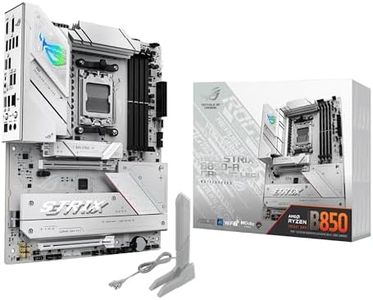
ASUS ROG Strix B850-A Gaming WiFi AMD AM5 B850 ATX Motherboard 14+2+2 Power Stages, DDR5 AEMP, 2.5G LAN, WiFi 7 with Q-Antenna, 4X M.2, PCIe® 5.0, USB 20Gbps Type-C, AI Networking II, ASUS AI Advisor

Rating
9.7
Expansion Slots and Connectivity
BIOS and Firmware

Most important from
386 reviews

Expansion Slots and Connectivity
Be aware that using the third M.2 slot will disable the bottom PCIe slot, so plan your components accordingly.
BIOS and Firmware
The motherboard worked flawlessly on the first boot, showcasing its reliability and user-friendliness.

The ASUS ROG Strix B850-A Gaming WiFi motherboard is packed with features that cater to high-performance computing, especially for gaming and advanced AI applications. Its AMD B850 chipset and AM5 socket make it compatible with the latest AMD Ryzen 9000, 8000, and 7000 series processors, ensuring strong performance for future-proof builds. The ATX form factor provides ample space for a variety of components, while the DDR5 RAM compatibility supports up to 192 GB with an impressive speed of 8000 MHz, making it ideal for memory-intensive tasks.

The 14+2+2 power stages and robust cooling solutions with massive heatsinks and high-conductivity thermal pads offer reliable power delivery and efficient thermal management, ensuring the system remains stable under heavy loads. Connectivity options are plentiful, with 4 M.2 slots, PCIe 5.0 support, and a USB 20Gbps Type-C port, as well as 2.5G LAN and WiFi 7 for fast and reliable networking. The intelligent control features, including ASUS AI Advisor and AI Networking II, simplify setup and optimize performance, making it user-friendly even for those less tech-savvy.

Its advanced features and high specifications come at a higher cost, which might be a consideration for budget-conscious users. Additionally, the cutting-edge technology such as DDR5 RAM and PCIe 5.0 may require compatible hardware upgrades that could add to the expense. This motherboard is an excellent choice for gamers and professionals looking for top-tier performance and future-proofing, with a wide array of expansion and connectivity options, although it may be overkill for more casual users or those on a tighter budget.

Rating
9.7
Expansion Slots and Connectivity
BIOS and Firmware

Most important from
386 reviews

Expansion Slots and Connectivity
Be aware that using the third M.2 slot will disable the bottom PCIe slot, so plan your components accordingly.
BIOS and Firmware
The motherboard worked flawlessly on the first boot, showcasing its reliability and user-friendliness.
#3

ASRock X870 Pro RS WiFi AMD Ryzen Socket AM5 ATX Motherboard USB4 DDR5 8000 MHz 256 GB SATA3 6.0 Gb/s

Rating
9.4
Power Delivery and VRM Quality
BIOS and Firmware
Expansion Slots and Ports

Most important from
151 reviews

Power Delivery and VRM Quality
The motherboard boasts a robust build with a sturdy backplate and strong power stages, ensuring stable and reliable performance.
BIOS and Firmware
Once BIOS settings are properly configured, the system boots quickly and runs rock solid, supporting intensive daily use without issues.
Expansion Slots and Ports
Modern connectivity options including dual USB4 Type-C ports and multiple M.2 slots offer excellent flexibility for high-speed storage and peripherals.
RAM Compatibility
The board supports high-speed DDR5 memory with EXPO profiles, but enabling these profiles requires manual BIOS configuration.

The ASRock X870 Pro RS WiFi motherboard is a strong choice if you're building a high-performance PC with AMD Ryzen 7000 or newer processors, thanks to its AM5 socket and modern X870 chipset. It supports DDR5 memory up to an impressive 8000 MHz, and can handle up to 256 GB RAM, which is great for demanding tasks or future-proofing. This board stands out with a robust 14+2+1 power phase design and Dr.MOS components, ensuring stable power delivery for overclocking or intensive workloads. Cooling is well thought out with multi-layer and bottom M.2 heatsinks, which help maintain SSD performance.

The inclusion of dual USB4 Type-C ports boosts connectivity options, alongside blazing fast PCIe Gen5 x4 M.2 slots for next-gen storage speeds. Networking is up-to-date with Wi-Fi 7, offering faster and more reliable wireless connections. The ATX form factor provides ample expansion slots, making it suitable for gamers and content creators who want flexibility.

This motherboard may be more expensive than mid-range boards, and the advanced features might exceed the needs of casual users. Additionally, setting up BIOS and firmware updates might require some familiarity with PC building basics. Audio quality is decent but not highlighted as a premium feature here. For enthusiasts aiming to maximize their Ryzen 9000 or 8000 series CPUs, the ASRock X870 Pro RS WiFi offers a future-ready, feature-rich Ryzen motherboard with top-tier connectivity and power delivery.

Rating
9.4
Power Delivery and VRM Quality
BIOS and Firmware
Expansion Slots and Ports

Most important from
151 reviews

Power Delivery and VRM Quality
The motherboard boasts a robust build with a sturdy backplate and strong power stages, ensuring stable and reliable performance.
BIOS and Firmware
Once BIOS settings are properly configured, the system boots quickly and runs rock solid, supporting intensive daily use without issues.
Expansion Slots and Ports
Modern connectivity options including dual USB4 Type-C ports and multiple M.2 slots offer excellent flexibility for high-speed storage and peripherals.
RAM Compatibility
The board supports high-speed DDR5 memory with EXPO profiles, but enabling these profiles requires manual BIOS configuration.

Buying Guide for the Best Ryzen Motherboard

Choosing the right motherboard for your Ryzen processor is crucial as it determines the compatibility, performance, and features of your entire system. A motherboard connects all the components of your computer, so it's important to pick one that meets your needs and supports your processor. Here are the key specifications to consider when selecting a Ryzen motherboard.
ChipsetThe chipset is a crucial part of the motherboard that determines its capabilities and compatibility with your Ryzen processor. Different chipsets offer varying levels of performance, features, and connectivity options. For example, high-end chipsets like X570 offer more PCIe lanes, better overclocking support, and more USB ports, while budget chipsets like A320 provide basic functionality. Choose a chipset that matches your performance needs and the features you require.
Socket TypeThe socket type is the physical interface between the motherboard and the processor. For Ryzen processors, the AM4 socket is the standard. Ensuring that the motherboard has the correct socket type for your Ryzen CPU is essential for compatibility. All Ryzen processors use the AM4 socket, but it's always good to double-check to avoid any mismatches.
Form FactorThe form factor of a motherboard determines its size and the type of case it will fit into. Common form factors include ATX, Micro-ATX, and Mini-ITX. ATX motherboards are larger and offer more expansion slots and features, while Micro-ATX and Mini-ITX are smaller and more compact, suitable for smaller cases. Choose a form factor that fits your case and meets your expansion needs.
RAM CompatibilityRAM compatibility refers to the type and amount of memory the motherboard can support. Ryzen motherboards typically support DDR4 RAM, but it's important to check the maximum supported speed and capacity. Higher RAM speeds can improve performance, especially in gaming and intensive applications. Ensure the motherboard supports the amount of RAM you plan to use and consider future upgrades.
Expansion Slots and PortsExpansion slots and ports determine the connectivity and expandability of your system. Look for the number and type of PCIe slots for graphics cards and other expansion cards, as well as USB ports, SATA ports for storage devices, and M.2 slots for NVMe SSDs. More slots and ports provide greater flexibility for adding components and peripherals. Choose a motherboard with the right balance of slots and ports for your current and future needs.
Power Delivery and VRM QualityPower delivery and VRM (Voltage Regulator Module) quality are important for stable and efficient power supply to the CPU, especially if you plan to overclock. A motherboard with a robust VRM design ensures better power management and stability under load. Look for motherboards with good VRM cooling solutions and higher phase counts for better performance and reliability. If you plan to overclock, prioritize motherboards with strong power delivery systems.
BIOS and FirmwareThe BIOS (Basic Input/Output System) and firmware of a motherboard control its basic functions and compatibility with hardware. A user-friendly BIOS with regular updates ensures better compatibility with new processors and features. Some motherboards offer advanced BIOS options for overclocking and fine-tuning system performance. Choose a motherboard with a reliable BIOS and good manufacturer support for updates.
Audio and NetworkingAudio and networking features can enhance your overall computing experience. Integrated audio solutions vary in quality, with some motherboards offering high-definition audio codecs for better sound quality. Networking options include Ethernet ports and, in some cases, built-in Wi-Fi. Consider your audio and networking needs and choose a motherboard that offers the features you require for a seamless experience.

FAQ

Most Popular Categories Right Now