We Use CookiesWe use cookies to enhance the security, performance, functionality and for analytical and promotional activities. By continuing to browse this site you are agreeing to our privacy policy

10 Best Sony Mirrorless Lenses 2025 in the United States

How do we rank products for you?

Our technology thoroughly searches through the online shopping world, reviewing hundreds of sites. We then process and analyze this information, updating in real-time to bring you the latest top-rated products. This way, you always get the best and most current options available.

headphones-stars

Our Top Picks

#1

Winner

Samyang 12mm F2.0 AF Ultra Wide Lens for Sony E – Weather-Sealed, UMC Coating, Fast F2 Aperture, Autofocus, Removable Hood, 62mm Filter, Compact APS-C, Night Sky & Architecture

Rating
10.0
Chosen by1,154
Focal Length
Aperture
Image Stabilization

Most important from
176 reviews

Focal Length
The ultra-wide 12mm focal length delivers impressively crisp and expansive shots, perfect for landscapes and cityscapes.
Aperture
The bright F2.0 aperture excels in low light, providing flexibility across diverse shooting conditions.
Image Stabilization
The lack of image stabilization means a tripod is recommended for night photography or dim environments.
Autofocus
Autofocus is generally fast and accurate, though it can occasionally hunt in lower light, making manual focus preferable in some scenarios.
Build Quality
Build quality feels solid and well-constructed, with a compact, lightweight design that’s comfortable for extended use.

The Samyang 12mm F2.0 AF lens is a solid choice for Sony E-mount APS-C mirrorless cameras, especially for those who want a wide-angle lens for landscapes, architecture, or night sky photography. Its ultra-wide 12mm focal length offers an impressively broad 99.1° field of view, making it great for capturing expansive scenes. The bright F2.0 aperture is a standout feature here, allowing you to shoot in low light with good sharpness and achieve nice background separation, which is handy for creative effects or astrophotography.

Autofocus performance is smooth and quiet thanks to the Linear STM motor, which helps both stills and video shooters, though lens stabilization isn’t included, so you might need a steady hand or a tripod for sharper shots in dim conditions. Build quality is another strong point, with a compact yet sturdy metal design, weather sealing, and a removable lens hood, keeping it durable and portable at just 213 grams.

The lens also features premium optical coatings to reduce glare and improve image clarity, although some users might find the lack of image stabilization limiting if they often shoot handheld in low light. Those seeking an affordable ultra-wide prime for night scenes or creative wide-angle shots on a Sony APS-C camera will find this lens fits nicely, balancing good optics and portability, even if it lacks some advanced features like stabilization.

Rating
10.0
Chosen by1,154
Focal Length
Aperture
Image Stabilization

Most important from
176 reviews

Focal Length
The ultra-wide 12mm focal length delivers impressively crisp and expansive shots, perfect for landscapes and cityscapes.
Aperture
The bright F2.0 aperture excels in low light, providing flexibility across diverse shooting conditions.
Image Stabilization
The lack of image stabilization means a tripod is recommended for night photography or dim environments.
Autofocus
Autofocus is generally fast and accurate, though it can occasionally hunt in lower light, making manual focus preferable in some scenarios.
Build Quality
Build quality feels solid and well-constructed, with a compact, lightweight design that’s comfortable for extended use.
#2

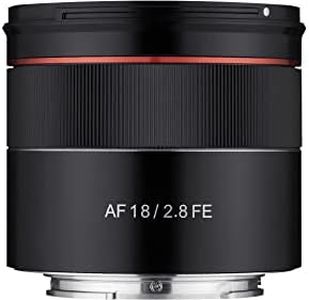
Samyang AF 18mm F2.8 Auto Focus Full Frame Wide Angle Lens for Sony E Mount – Compact, Ultra Lightweight, 58mm Filter Thread, High Resolution Optics, Quiet STM Autofocus

Rating
9.7
Weight and Size
Autofocus
Build Quality

Most important from
252 reviews

Weight and Size
Extremely lightweight design makes it a feather-light alternative to heavier wide-angle lenses.
Autofocus
Autofocus operates quickly and accurately with quiet, smooth performance ideal for both video and photography.
Build Quality
Build quality is adequate but feels plasticky, and the included lens hood seems cheaply made.

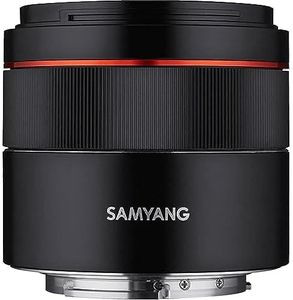
The Samyang AF 18mm F2.8 lens is a wide-angle lens designed for Sony E-mount cameras, compatible with both full-frame and APS-C sensors. Its 18mm focal length provides a broad perspective, making it ideal for landscapes, architecture, and indoor photography where capturing more in one frame is desired. The maximum aperture of f/2.8 allows for decent low-light performance and some background blur, although it is not the fastest lens on the market.

Autofocus is driven by a quiet STM motor, ensuring smooth and silent operation, which benefits both video recording and casual photography. While the lens does not include built-in image stabilization, it is lightweight and compact, weighing just over 5 ounces and measuring about 2 inches in diameter, making it easy to carry without bulk. The build quality is solid, featuring a metal mount and reinforced glass for reliable durability during regular use. It accepts common 58mm filters that are easy to find.

This lens is an excellent choice for photographers seeking an affordable, lightweight wide-angle option for everyday shooting on Sony mirrorless cameras without requiring professional-level complexity. However, since it lacks image stabilization, users might need a steady hand or a tripod when shooting in low-light conditions.

Rating
9.7
Weight and Size
Autofocus
Build Quality

Most important from
252 reviews

Weight and Size
Extremely lightweight design makes it a feather-light alternative to heavier wide-angle lenses.
Autofocus
Autofocus operates quickly and accurately with quiet, smooth performance ideal for both video and photography.
Build Quality
Build quality is adequate but feels plasticky, and the included lens hood seems cheaply made.
#3

Sony FE 50-150 F2 GM

Rating
9.4
Aperture
Autofocus
Weight and Size

Most important from
13 reviews

Aperture
The constant F2 aperture provides a valuable extra stop over F2.8, enhancing subject isolation and keeping ISO levels low in indoor sports settings.
Autofocus
Autofocus is sharp and reliable once properly tuned, rarely missing focus even in fast-paced shooting scenarios.
Weight and Size
The lens is notably hefty, heavier than comparable zooms like the 70-200mm F2.8, which may affect handheld or travel use.
Image Stabilization
While it lacks built-in image stabilization and panning modes, increasing shutter speed effectively counters occasional motion blur.

The Sony FE 50-150 F2 GM lens is a standout choice for photographers using Sony full-frame mirrorless cameras who want a versatile telephoto zoom. Its focal length range of 50-150mm covers a good middle ground, making it suitable for portraits, events, and some wildlife shots. What really sets this lens apart is its constant wide F2 aperture—a rare feature for a zoom lens at this focal length—which allows for great low-light performance and beautifully blurred backgrounds that make your subject pop.

Autofocus is fast and accurate, working well for both still images and video, which is helpful if you switch between shooting styles. The lens offers internal zooming and smooth zoom control, improving handling and keeping the lens size manageable, though it still weighs nearly 3 pounds, so it’s a bit on the heavier side for travel or long handheld sessions. While the lens itself does not include built-in image stabilization, many Sony bodies feature stabilization that works effectively with this lens.

The build quality is solid, reflecting its premium G Master status, so it feels durable and professional. If you want a high-quality, sharp lens with excellent bokeh and reliable autofocus for your Sony mirrorless system, this lens is a strong candidate, especially if you prioritize low-light ability and subject separation. However, the weight and price could be considerations for some users.

Rating
9.4
Aperture
Autofocus
Weight and Size

Most important from
13 reviews

Aperture
The constant F2 aperture provides a valuable extra stop over F2.8, enhancing subject isolation and keeping ISO levels low in indoor sports settings.
Autofocus
Autofocus is sharp and reliable once properly tuned, rarely missing focus even in fast-paced shooting scenarios.
Weight and Size
The lens is notably hefty, heavier than comparable zooms like the 70-200mm F2.8, which may affect handheld or travel use.
Image Stabilization
While it lacks built-in image stabilization and panning modes, increasing shutter speed effectively counters occasional motion blur.

Buying Guide for the Best Sony Mirrorless Lenses

Choosing the right Sony mirrorless lens can significantly enhance your photography experience. The right lens will depend on what you plan to shoot, your skill level, and your personal preferences. Understanding the key specifications of lenses will help you make an informed decision that best suits your needs.
Focal LengthFocal length is the distance between the lens and the image sensor when the subject is in focus, usually stated in millimeters (mm). It determines the field of view and how much of the scene will be captured. Wide-angle lenses (10-35mm) are great for landscapes and architecture, standard lenses (35-70mm) are versatile for everyday use, and telephoto lenses (70mm and above) are ideal for wildlife and sports photography. Choose a focal length based on the type of photography you are interested in.
ApertureAperture refers to the size of the lens opening that allows light to enter the camera. It is expressed in f-numbers (e.g., f/1.8, f/2.8). A lower f-number means a larger aperture, which allows more light and is better for low-light conditions and achieving a shallow depth of field (blurry background). Higher f-numbers mean a smaller aperture, suitable for well-lit conditions and greater depth of field. If you often shoot in low light or want to create a bokeh effect, go for lenses with a lower f-number.
Image StabilizationImage stabilization helps reduce blur caused by camera shake, especially useful in low-light conditions or when using a telephoto lens. Some lenses come with built-in stabilization, which can be beneficial if your camera body does not have this feature. If you frequently shoot handheld or in challenging lighting conditions, consider a lens with image stabilization.
AutofocusAutofocus (AF) is the lens's ability to automatically focus on the subject. Fast and accurate autofocus is crucial for capturing sharp images, especially in action or wildlife photography. Lenses with advanced AF systems are better for tracking moving subjects. If you shoot fast-moving subjects or need quick focus adjustments, prioritize lenses with superior autofocus performance.
Lens MountThe lens mount is the interface between the camera body and the lens. Sony mirrorless cameras typically use the E-mount system. Ensure that the lens you choose is compatible with your camera's mount. If you have a full-frame camera, look for FE lenses, while APS-C cameras can use both E and FE lenses. Compatibility is key to ensuring the lens works seamlessly with your camera.
Build QualityBuild quality refers to the materials and construction of the lens. Lenses with metal bodies and weather-sealing are more durable and can withstand harsh conditions. If you often shoot outdoors or in challenging environments, investing in a lens with robust build quality is advisable. For casual or indoor photography, standard build quality may suffice.
Weight and SizeThe weight and size of the lens can affect your shooting experience, especially if you plan to carry your camera for extended periods. Compact and lightweight lenses are easier to handle and more portable, making them ideal for travel and street photography. Larger and heavier lenses may offer better performance but can be cumbersome. Consider your comfort and shooting style when choosing the size and weight of the lens.

FAQ

Most Popular Categories Right Now