We Use CookiesWe use cookies to enhance the security, performance, functionality and for analytical and promotional activities. By continuing to browse this site you are agreeing to our privacy policy

10 Best Cheap 3D Printers 2025 in the United States

How do we rank products for you?

Our technology thoroughly searches through the online shopping world, reviewing hundreds of sites. We then process and analyze this information, updating in real-time to bring you the latest top-rated products. This way, you always get the best and most current options available.

headphones-stars

Our Top Picks

#1

Winner

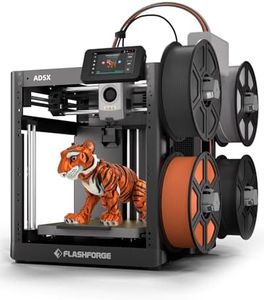
FLASHFORGE AD5X Multi-Color 3D Printer, CoreXY 600mm/s High-Speed, 1-Click Auto Leveling, 300°C Direct Drive Extruder, 220x220x220mm Build Volume, Ideal for Precision and Efficiency

Rating
10.0
Chosen by1,213
Print Volume
Print Speed
Filament Compatibility

Most important from
269 reviews

Print Volume
The printer’s moderate build volume suits standard projects but may limit very large prints.
Print Speed
Printing speed is impressively fast, outperforming many competitors even with high-quality results.
Filament Compatibility
Multi-color printing and compatibility with a wide range of filaments add creative versatility not common in this price range.
Bed Leveling
Auto bed leveling simplifies calibration, making the printing process smoother and reducing failed prints.
Connectivity Options
Connectivity via USB works well, though the lack of wireless or SD card options feels outdated.
Build Quality
The metal frame construction provides solid stability during printing, contributing to consistent quality.

The Flashforge AD5X stands out in the budget 3D printer category by offering a respectable build volume of 220x220x220mm, suitable for many standard projects. Its CoreXY design and ultra-fast printing speed of up to 600mm/s allow for quicker printing compared to many entry-level printers, making it a good choice if speed is important. The 300°C direct drive extruder supports a diverse range of filaments, including flexible and specialty materials, which adds versatility.

A notable feature is its vivid multi-color print capability with up to 4 colors at once, providing creative flexibility that most cheap printers don’t offer. The 1-click auto bed leveling simplifies setup and reduces failed prints, which is great for users not wanting to manually calibrate. Additionally, smart features like power loss resume, automatic filament feeding, and remote monitoring through an app improve convenience and user experience. Build quality is solid with a metal frame, contributing to stability during printing.

The print volume is moderate rather than large, so very big projects may require a different model. While it offers multiple nozzle sizes for detail or speed, the printer’s advanced features might come with a steeper learning curve for absolute beginners. Connectivity options are limited to PC connection, lacking wireless or SD card options commonly found in other models. This makes the Flashforge AD5X a strong contender for users looking for a fast, multi-color 3D printer with good material support and ease of use features at a lower price, but those needing very large prints or simpler connectivity might want to explore alternatives.

Rating
10.0
Chosen by1,213
Print Volume
Print Speed
Filament Compatibility

Most important from
269 reviews

Print Volume
The printer’s moderate build volume suits standard projects but may limit very large prints.
Print Speed
Printing speed is impressively fast, outperforming many competitors even with high-quality results.
Filament Compatibility
Multi-color printing and compatibility with a wide range of filaments add creative versatility not common in this price range.
Bed Leveling
Auto bed leveling simplifies calibration, making the printing process smoother and reducing failed prints.
Connectivity Options
Connectivity via USB works well, though the lack of wireless or SD card options feels outdated.
Build Quality
The metal frame construction provides solid stability during printing, contributing to consistent quality.
#2

AOSEED X-Maker 3D Printer for Kids and Beginners, Fully Assembled High-Speed 3D Printer with 8 PLA Filament Set, Leveling-Free Bed, Wi-Fi Printing, Resume Printing, Silent, High Precision, with App

Rating
9.4
Print Resolution

Most important from
133 reviews

Print Resolution
Prints come out with high quality, delivering detailed results that exceed expectations for the price.

The AOSEED X-Maker 3D Printer is a strong option for beginners and kids who want to explore 3D printing without much hassle. It comes fully assembled, so you can start printing right away, which is great if you want a simple setup. The printer offers high precision with a resolution as fine as 0.05 mm, allowing detailed prints, and supports print speeds up to 160 mm/s, which is relatively quick for this price range. Its print volume is suitable for small to medium projects, making it a good fit for home or classroom use.

A notable feature is the leveling-free bed, which means you don’t have to manually adjust the print surface—this reduces common beginner frustrations. The magnetic, flexible build plate also makes it easy to remove prints safely. Connectivity options include Wi-Fi, SD card, and USB, giving you flexibility in how you send print jobs. The printer only uses PLA filament, which is common and easy to work with, but it doesn’t support other filament types or multi-color printing, limiting creativity if you want more advanced materials or color variety. It also operates quietly (under 50 dB), so it won’t be disruptive during use.

The build is primarily plastic and metal, typical but not the most durable for heavy use. The enclosed design helps with safety and print quality but makes the printer a bit bulky (over 17 inches in all dimensions). For those new to 3D printing or buying for kids, the AOSEED X-Maker provides a user-friendly, quiet, and accurate experience with hassle-free setup and decent speed. However, if you’re looking for a larger print area, multiple filament types, or advanced features, this model might feel limited.

Rating
9.4
Print Resolution

Most important from
133 reviews

Print Resolution
Prints come out with high quality, delivering detailed results that exceed expectations for the price.
#3

FLASHFORGE 3D Printer AD5M, CoreXY 600mm/s High-Speed Printer with 1-Click Auto Leveling, High-Temp Direct Drive Extruder, 3s Quick-Swap Nozzle, 220×220×220mm Build Volume

Rating
9.1
Print Volume
Print Speed
Filament Compatibility

Most important from
269 reviews

Print Volume
The build volume suits small to medium projects well, but users seeking larger prints might find it restrictive.
Print Speed
The print speed and quality strike a solid balance, though dialing in settings can require some trial and error.
Filament Compatibility
Changing filament mid-print is surprisingly easy, enabling smooth color swaps without errors.
Bed Leveling
The 1-click auto bed leveling works seamlessly, avoiding common calibration headaches.
Connectivity Options
WiFi connectivity is functional but could be more user-friendly and modern.
Build Quality
The metal frame and build quality inspire confidence in the printer's durability and reliability.

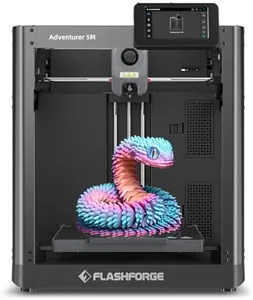
The FLASHFORGE AD5M is a fast and reliable 3D printer designed for users looking for good performance without a high price tag. It offers a solid build volume of 220×220×220mm, which is typical for budget-friendly printers, suitable for most small to medium projects. Thanks to its CoreXY design and a top print speed of 600mm/s, it stands out in speed compared to many competitors, making it a great choice if you want quick prototypes or faster printing jobs. The printer’s 1-click auto bed leveling simplifies setup, which is helpful for beginners, ensuring the print bed is properly calibrated for the first layer—a common pain point in 3D printing. It supports a high-temperature direct drive extruder reaching up to 280°C, allowing for a wide range of filaments, including some tougher materials like PETG or TPU, giving you flexibility in your projects.

The quick-swap nozzles and dual cooling fans help balance print quality and speed, but achieving very detailed prints might require some adjustments or slower printing speeds. Connectivity options include remote monitoring via an app, which adds convenience and control, while features like power loss recovery and filament runout detection reduce failed prints. The metal frame suggests good build quality, but the printer's weight and size may require dedicated workspace. Some users might find the open-source nature appealing for future upgrades, though beginners should be aware that advanced settings might take time to master.

This printer suits hobbyists, educators, and small workshops seeking speed and versatility on a budget. If ultra-fine detail or a larger build volume is a priority, other models might better meet those needs.

Rating
9.1
Print Volume
Print Speed
Filament Compatibility

Most important from
269 reviews

Print Volume
The build volume suits small to medium projects well, but users seeking larger prints might find it restrictive.
Print Speed
The print speed and quality strike a solid balance, though dialing in settings can require some trial and error.
Filament Compatibility
Changing filament mid-print is surprisingly easy, enabling smooth color swaps without errors.
Bed Leveling
The 1-click auto bed leveling works seamlessly, avoiding common calibration headaches.
Connectivity Options
WiFi connectivity is functional but could be more user-friendly and modern.
Build Quality
The metal frame and build quality inspire confidence in the printer's durability and reliability.

Buying Guide for the Best Cheap 3D Printers

Choosing the right 3D printer can be a bit overwhelming, especially if you're new to the world of 3D printing. The key is to understand what features are most important for your needs and how to evaluate them. Here are some key specifications to consider when selecting a 3D printer, along with explanations to help you make an informed decision.
Print VolumePrint volume refers to the maximum size of the object that the 3D printer can produce. This is important because it determines the scale of your projects. Print volumes are usually measured in cubic inches or millimeters. Small print volumes (e.g., 100x100x100 mm) are suitable for hobbyists and small projects, while larger volumes (e.g., 300x300x300 mm) are better for more ambitious creations. Consider what you plan to print and choose a printer with a volume that matches your needs.
Print ResolutionPrint resolution indicates the level of detail a 3D printer can achieve, measured in microns. Lower micron values mean higher resolution and finer details. For example, a resolution of 100 microns is standard for most consumer 3D printers and is sufficient for general use. If you need highly detailed prints, look for a printer with a resolution of 50 microns or lower. Think about the level of detail required for your projects to determine the appropriate resolution.
Print SpeedPrint speed measures how quickly a 3D printer can produce an object, typically in millimeters per second (mm/s). Faster print speeds can save time, but they may also reduce print quality. Entry-level printers often have speeds around 40-60 mm/s, while more advanced models can reach 150 mm/s or higher. If you need to produce prints quickly, opt for a higher speed, but if quality is more important, a slower speed may be preferable.
Filament CompatibilityFilament compatibility refers to the types of materials a 3D printer can use. Common filaments include PLA, ABS, and PETG, each with its own properties. PLA is easy to use and environmentally friendly, making it ideal for beginners. ABS is more durable and heat-resistant but requires a heated bed. PETG combines the ease of PLA with the strength of ABS. Consider what materials you want to work with and ensure the printer supports them.
Bed LevelingBed leveling is the process of ensuring the print bed is perfectly flat and at the correct distance from the nozzle. This is crucial for print quality and adhesion. Manual leveling requires you to adjust the bed yourself, which can be time-consuming. Automatic leveling uses sensors to adjust the bed, making the process easier and more accurate. If you prefer convenience and precision, look for a printer with automatic bed leveling.
Connectivity OptionsConnectivity options determine how you can send print jobs to the 3D printer. Common options include USB, SD card, and Wi-Fi. USB and SD card are straightforward and reliable, while Wi-Fi allows for wireless printing and remote monitoring. If you value convenience and the ability to manage prints from a distance, choose a printer with Wi-Fi capabilities. Otherwise, USB or SD card options are sufficient for most users.
Build QualityBuild quality refers to the overall construction and durability of the 3D printer. A well-built printer will have a sturdy frame, high-quality components, and reliable performance. Metal frames are generally more durable than plastic ones. Good build quality ensures the printer will last longer and produce consistent results. Consider how often you plan to use the printer and choose one with a build quality that matches your usage.

FAQ

Most Popular Categories Right Now