We Use CookiesWe use cookies to enhance the security, performance, functionality and for analytical and promotional activities. By continuing to browse this site you are agreeing to our privacy policy

10 Best Printers 2026 in the United States
How do we rank products for you?

Our technology thoroughly searches through the online shopping world, reviewing hundreds of sites. We then process and analyze this information, updating in real-time to bring you the latest top-rated products. This way, you always get the best and most current options available.

headphones-stars

Our Top Picks

#1

Winner

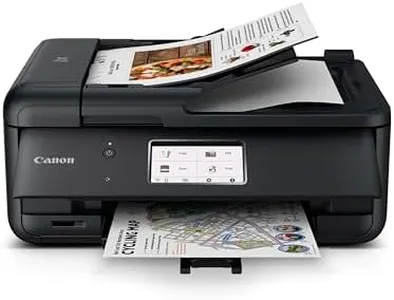
Canon PIXMA TR8620a - All-in-One Printer Home Office|Copier|Scanner|Fax|Auto Document Feeder | Photo, Document | Airprint (R), Android, Black, Works with Alexa

Rating
10.0
Chosen by1,122
Print Quality (DPI)
Print Speed (PPM)
Connectivity Options

Most important from
6409 reviews

Print Quality (DPI)
Crisp output and better colors even with the 'standard' setting make this printer a big step up from older models.
Print Speed (PPM)
The print speed is faster than anticipated and ink consumption is clearly better than prior Canon units.
Connectivity Options
Linking to WiFi was simple and quick, with no encountered issues using Canon software setup.
Operating Costs
Larger cartridges are available that are less expensive per page than any Epson equivalents.
Additional Features
The GUI/LED panel has all the functions you could look for and is intuitive, making it easy to operate without a manual.

The Canon PIXMA TR8620a is an all-in-one inkjet printer designed for home and small office use, offering printing, copying, scanning, and faxing capabilities. It features wireless connectivity and is compatible with Alexa, which can help manage your ink supplies through smart reorders. The print quality is good, as expected from an inkjet printer, and it supports borderless printing up to 8.5 x 11 inches, which is great for photos and documents.

The print speed is moderate, with 15 pages per minute (ppm) for black and white and 10 ppm for color. It includes a 200-sheet paper capacity divided between a 100-sheet front cassette and a 100-sheet rear feed, which is suitable for moderate use. The automatic document feeder (ADF) can hold up to 20 sheets, simplifying multi-page scanning and copying tasks.

Operating costs may be higher due to the five individual ink tanks, but the smart reorder feature can help manage ink supply more efficiently. Additional features include a Micro SD slot, auto duplex printing, and an ENERGY STAR certification. This printer would be ideal for users needing versatile functionality, moderate print volumes, and the convenience of smart home integration.

Rating
10.0
Chosen by1,122
Print Quality (DPI)
Print Speed (PPM)
Connectivity Options

Most important from
6409 reviews

Print Quality (DPI)
Crisp output and better colors even with the 'standard' setting make this printer a big step up from older models.
Print Speed (PPM)
The print speed is faster than anticipated and ink consumption is clearly better than prior Canon units.
Connectivity Options
Linking to WiFi was simple and quick, with no encountered issues using Canon software setup.
Operating Costs
Larger cartridges are available that are less expensive per page than any Epson equivalents.
Additional Features
The GUI/LED panel has all the functions you could look for and is intuitive, making it easy to operate without a manual.

Buying Guide for the Best Printers

Choosing a printer can seem overwhelming, but knowing your needs can make the process much easier. Start by thinking about what you'll be using the printer for most often, such as documents, photographs, or both. Consider how much you plan to print, how often, and whether you need special features like scanning or wireless printing. By focusing on how and where the printer will be used, you can find a model that's a good fit for your everyday tasks.
Printer TypeThere are two main types of printers: inkjet and laser. Printer type refers to the technology the printer uses to create prints. Inkjet printers use liquid ink and are good for printing photos and color documents, but may be slower than laser printers. Laser printers use toner (powder) and tend to be faster, making them ideal for text-heavy documents and higher-volume printing. If you mainly print photos or a mix of colors, inkjet is usually the way to go. If you mostly print documents or need to print in bulk, consider a laser printer.
Print ResolutionPrint resolution is measured in dots per inch (DPI) and indicates how sharp and detailed the images and text will appear. Higher DPI means more detail, which is especially important for photos or graphics. For standard document printing, a lower DPI is usually acceptable and faster, while for photo printing, a higher DPI will give you better results. Think about the type of work you'll do most often; if it's just school or work documents, you don't need the highest DPI, but for photo projects, opt for something higher.
Print SpeedPrint speed is usually measured in pages per minute (PPM) and shows how quickly a printer can produce pages. This is important if you need to print a lot at once or don't want to wait for your documents. Lower speeds are fine if you print occasionally or just a few pages at a time, but if you're frequently printing lengthy documents or sharing the printer with others, a higher PPM will save time and hassle.
Connectivity OptionsConnectivity refers to how the printer connects to your devices. Common options include USB, Wi-Fi, Bluetooth, and sometimes Ethernet. Wireless features like Wi-Fi or Bluetooth are useful if you want to print from multiple devices or from your phone, while a USB connection can be more reliable but requires a cable. If you plan to share the printer or print from multiple devices, look for strong wireless features; otherwise, a simple wired connection may be enough.
All-in-One FeaturesSome printers offer extra functions such as scanning, copying, and faxing, often described as 'all-in-one' or 'multifunction'. This is important if you need to digitize documents, make copies, or send faxes. If you only need to print, a basic printer is simpler and can take up less space. But if you also need to scan or copy, an all-in-one device will meet those needs without requiring several separate machines.
Paper HandlingPaper handling means the size and types of paper the printer can use, how much it can hold at once, and special features like double-sided printing (duplex). If you print on different paper sizes or need to print on specialty papers, look for a printer that supports these formats. For regular home or office needs, standard paper handling is fine, but if you want automatic double-sided printing or need to handle envelopes and labels, check these specs closely.
Operating CostsOperating costs refer to how much you’ll spend on ink or toner and maintenance over time. Some printers have cheap upfront prices but expensive ink replacements, while others are more efficient. If you plan to print frequently, consider printers known for lower-cost cartridges or refillable tanks. If your printing is occasional, this might be less of a concern.
Size and DesignSize and design refer to the physical dimensions and style of the printer. Larger printers may have more features or bigger paper trays, but take up more space. Compact printers are easier to fit in small workspaces but may be slower or have fewer options. Think about where you’ll put the printer and how much space you have before deciding.

FAQ

Most Popular Categories Right Now